Wednesday, July 25, 2018

Another Scarecrow Harvest Festival Preview

Nunce and Hapax
Today I’m posting a couple more pages-in-progress from the scarecrow book I’m writing and illustrating for my son. It’s a slow process as I’m juggling this book along with a job and kids plus general house maintenance. A pretty common situation for most working artists, really. But I’m still aiming to finish it by Halloween, or Christmas at the latest.

As I mentioned in an earlier post,  I came up with back stories for most of my scarecrow characters. I posted a few of them on another blog but unfortunately didn’t have time to keep up with it. Once this picture book is done, however, I’ll put all the stories together in a companion book.

For now, though, here are a couple of their stories.

Nunce: Each scarecrow in the River Valley receives a unique Animating Name that imbues them with life. The short names by which they are commonly known are but a tiny fragment of this true, longer name, which can take several hours to speak. These names are small pieces of power from the Autumnal Powers themselves.

Nunce is the scarecrow who sits at the desk beside the Powers, transcribing their words into Animating Names. There are far too many scarecrows in the Valley for Nunce to deliver every name herself. Instead she passes the name off to her servants, the wugs, for delivery. The wugs resemble simple bird drawings- little more than a rounded body with two sticks for legs and the vaguest suggestion of a beak. The wugs are paper-thin and can float easily on the wind like fallen leaves, or slip under the door of a house.

(Wugs, by the way, were inspired by the Wug Test of Jean Berko Gleason, a psycholinguist who studies, among other things, language acquisition in children)

(Nunce’s original name was actually Nonce, a term for a word that is coined for a single use. Nonce is also, unfortunately, British slang for a pedophile, so I changed the spelling a little to distance the name from that connotation whilst keeping the same basic linguistic concept).
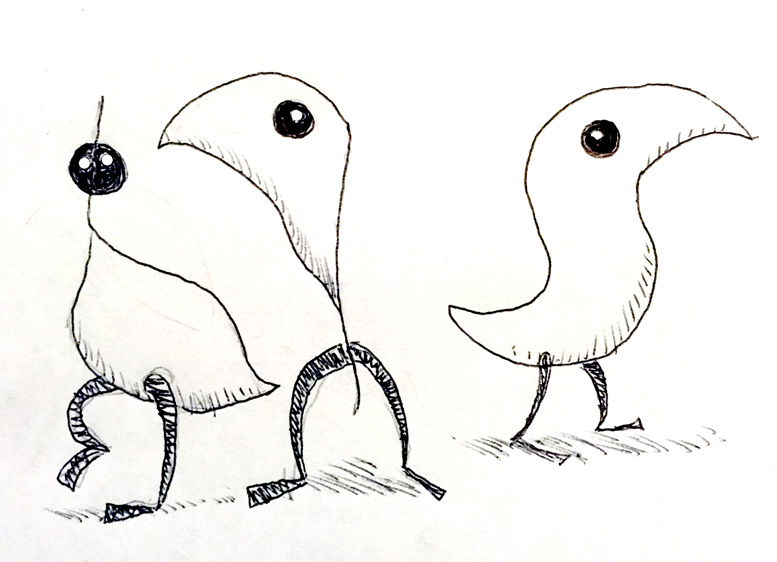
A couple of Wugs

Hapax: Another scribe for the Autumnal powers alongside his sister, Nunce. But while Nunce takes words directly from the lips of the Autumnal Powers, Hapax- and his own army of wugs- scour the libraries of mankind to find mortal words to give character to the Animating Names.  Sometimes he comes across written words that are known today only from a single use in a dead or forgotten tongue. Perhaps other references to the word are lost. Perhaps it was created for a single, special occasion. Whatever their origins, these single-use words have a particular potency. They are given to scarecrows of special import. Those who serve a key function in the River Valley. The scarecrows who guard the fields set aside for the dead, for example. Or scarecrows who inhabit fields marked by significant events, important battles, and geological anomalies.

Dwizzen and Cucupha


Dwizzen: The story of Dwizzen is really the story of Elihu March and Thomas Steiner, two young men from farming families in the River Valley.

When Elihu was five years old, an accident left him paralyzed from the waist down. Though his father was compassionate, his brothers and children from neighboring farms mocked him relentlessly for his disability, calling him useless and a burden.  One boy did not, though. Since he first learned to talk, Thomas Steiner struggled with a severe stutter that made even simple sentences difficult. He felt a deep kinship with Elihu and the two became fast friends.

In Thomas’ father’s field was a copse of trees used as a windbreak that the boys often used as a refuge from the mockery they endured on a daily basis. Thomas would carry Elihu to the trees in the early morning where the latter would spend the day with the books his father bought for him. At night Elihu would regale Thomas- and eventually some of the other farm children- with the things he had learned. He told them tales of the giant birds that had once roamed the Valley and left their fossilized footprints in the brownstone.  He told them of the preacher who had tried to build a metal messiah. He told them of the great city to the west that was the center of the world where every language was spoken. He also helped Thomas work on his stutter by giving him poems and speeches to read slowly out loud.

One day Thomas and Elihu went out to their landlocked island after a strong nor’easter had blown through. Several trees had been knocked down and Elihu noticed that a small army of seedlings had sprung up on them. He’d read books on botany and was keen to study the new sprouts. Soon he noticed that the plants formed micro-environments on different parts of the fallen trees. The flora growing on top of the root-ball was different from the flora growing in the pit, which was different from the mosses, lichens and liverworts growing on the roots themselves, which were all different from the other plants in the copse. Elihu took careful notes on his findings and with the encouragement of his father and Thomas he submitted them to a botanist at the nearby college. To his surprise the professor wrote back, impressed with his work, and invited Elihu to give a lecture on his findings. Word of his research soon spread to other members of the faculty and to other universities of the River Valley. He received more offers to speak about his discovery and was soon making a regular lecture circuit. At first, he was carried into the halls on Thomas’ back, but soon one of the professors donated a wheelchair so the boy could get around easier.

Thomas and Elihu grew ever closer and soon their friendship developed into something more. When Elihu’s father passed away, the two of them moved into his old farmhouse together. They wed the next spring with a ceremony in the old copse of trees where they had spent so much time in their youth.

In time the expanding town bought up Elihu and Thomas’ land to make way for expansion. When the couple moved to a new farm, they took one of the old, tipped-over logs with them as a reminder of their home. Weathering and cracking had given the stump the rough semblance of a face, so Thomas and Elihu thought it would be only appropriate to give it a body as well. The log head was too heavy for the body to hold up, but as it happened, Elihu was looking to obtain a new wheelchair and gave the old one to the scarecrow, whom the Autumnal powers named Dwizzen.

Recently Dwizzen’s chair has been fitted with bicycle wheels to make it easier for him to navigate his fields. Like his human creators, Dwizzen is interested in the succession of plant communities. He has seen neighboring fields go fallow and give way to meadow then savannah then young forest. He often ponders what will happen when his own field is finally reclaimed by the land. Perhaps he himself will become the nursery for a new forest.

(The design and backstory for Dwizzen were inspired by the ecological concept of pit-and-mound topography.)

Cucupha: this scarecrow had been guarding his fields for many decades without anything very interesting happening. Until the day something finally did. One early spring morning, a group of strange men came to the fallow meadow adjacent to his cornfield. They worked for many days, on what exactly he did know, for the project was guarded day and night and he dared not approach close to see what it was. When they left at last, he crept to the meadow and discovered a giant arrow of poured concrete lying flat in the grass, pointing to the West. He spent many a night staring at it from the edge of his field, wondering what it could be for.

One day a strange bird flew over his field. It was larger than any bird he’d ever seen before. Its wings were stiff and dark. The creature did not have any feathers that he could see.  Only smooth, white and gray flesh. It flew in a straight line, not swooping or banking like other birds. Cucupha was frightened by this odd creature, but he knew he had to do his job. He ran out into the open field, waving his arms to spook it. The bird did not cry out or swerve away as others did, but Cucupha’s efforts must have worked, for instead of landing to steal his crops, it continued on its way until it disappeared in the distance.

Things were quiet for a while after that. But a few days later another odd stiff-winged bird flew overhead. Again he ran out to spook the bird, and again it continued on its unwavering path to the west. Later that night another odd bird flew by, lower this time. And again he made a ruckus to scare it away. Then another the next day. And another. Soon there were strange birds flying overhead almost every day.

Where were all these avian aggressors coming from? It soon dawned on him that they had only started appearing after the men built that concrete arrow in the meadow. It must be some sort of beacon to the birds, he reasoned. Surely the men must have been jealous of his fields- the best fields in the River Valley- and had put up the arrow to summon the monster birds to devour his grain. But Cucupha would not allow that. He began to spend more time at the concrete arrow, waiting for the birds to come so he could chase them away.

When the farmer noticed Cucupha wasn’t in the fields anymore, he put up a new, non-living scarecrow. This didn’t bother the old scarecrow, though. Now he could devote more time to chasing off the monster birds.

In time the farmer moved away and the fields were left fallow. Meadow grass moved in to replace the grain. But Cucupha never noticed. All that mattered to him now was keeping the strange birds away.

By now readers may have figured out that the strange birds were actually airplanes. In recent years, the River Valley Postal Service has started using these new technological marvels to transport mail across the continent. The only problem is the long trips are difficult to navigate. While pilots can guide themselves by landmarks on short voyages, it’s all too easy to get lost on the long journey from coast to coast. To help their pilots, the Postal Service has erected a series of large concrete arrows all across the country. The markers are large enough to see from the air, and some are even lit up at night with torches. You can learn more about the Postal Service Arrows here.


Monday, June 18, 2018

Podcast Review: Literary Wonder and Adventure Show


I found the Literary Wonder and Adventure podcast last year while searching for something to keep me company on a fossil-hunting trip to the Catskills. After listening to a few episodes I discovered that host Robert Zoltan and his snarky companion Edgar the raven make perfect travel companions.

Zoltan (who is also the show’s producer, writer, composer, sound-mixer, editor and a dozen other occupations) travels the multiverse with Edgar (who is, well, a black-feathered bird. Voiced by Zoltan. I’m sure he does other things too. Maybe ), in their dimension-hopping domicile, the Dream Tower, in quest of speculative fiction authors to interview.  Interview, though, may not be an accurate description,  because the show is more than simple question-and-answer.   Each episode is a full conversation with many asides and much meandering. But it is meandering in an interesting way, leading you places you might never have thought to look.  Zoltan and his guests discuss the art of writing speculative fiction, often via the works of classic authors like Robert E Howard, Clark Ashton Smith, Edgar Rice Burroughs, J. R. R. Tolkien, and more. They illuminate the lives of classic pulp and fantasy authors in ways that you might not have seen.

Zoltan’s guests also talk about their own writing and creative inspirations, which can become quite personal at times. I was especially drawn to author Scott Oden’s description of that timeless, almost child-like feeling of discovery one gets from the creative process. I also related all too well to his past struggles with dark feelings and how writing was a life raft in that tumultuous sea.  

I’m interested in the history of speculative fiction, so I also quite enjoyed Zoltan’s two-part conversation with author Allen Steele about the Golden Age of Science Fiction. Though SF has its roots in the works of Jules Verne, J.-H. Rosny,  H. G. Wells and Mary Shelley’s Frankenstein (and, one could argue, Margaret Cavendish’s The Blazing World), Steele suggests that the genre’s modern incarnation really began with Hugo Gernsback’s 1926 publication of Amazing Stories and fully crystallized with the 1939 issue of Astounding Stories, which featured some of the first stories from early SF legends like A. E. van Vogt, Isaac Asimov, C. L. Moore and others.

 As I drove through upstate New York in search of stromatolites and petrified Devonian trees, I felt as though I was listening to old friends having a scintillating conversation in the back seat.  The podcast’s format may not be for everyone, especially those looking for a typical Q & A, but it is greatly rewarding if you are a fan of more casual, discussion-format shows. Episodes warrant a second- and a third and fourth- listen to pick up and follow all the places Robert and his guests go.
Each installment is bookended with vignettes from Robert and Edgar’s latest adventure across the dimensions. In the course of the show, they’ve fended off vicious pterodactyls, tricked a revenge-seeking orc, dealt with a high-tech vacuum cleaner that has achieved inconvenient sentience and lived through even stranger oddities.

Zoltan spices the podcast with audio adventures, usually featuring his Leiberesque sword and sorcery rogues Dareon and Blue. These are fully realized productions brought to life with full sound effects and ambient music on par with classic radio dramas,. In their first adventure, Dareon and Blue tangle with a strange merchant and his eerie, sorcerously cerulean lamp. In their second outing, the pair protects a ship of traders on a journey through a sweltering river delta choked with mangroves, flies and dormant eldritch horrors.

The show’s theme song (composed and performed by Zoltan, of course. I doubt Edgar has the dexterity to work a synthesizer) is appropriately big and bombastic. It is the overture to a lone rider and horse galloping across the steppes to clash swords with a demon awakened from eons-long slumber in a forgotten tomb. Or perhaps it is the accompaniment to an Art Deco rocketship trailing fire as it launches from a Martian outpost to explore the star-dappled infinite night. Whatever it is, it’ll definitely get stuck in your head.


 Coming in at over an hour each episode, the Literary Wonder and Adventure Show is a great podcast for listening to on a long trip in quest of ancient sawtooth sharks (or any other type of quest, really), or while you’re writing, drawing or engaged in more esoteric creative pursuits.

You can find the Literary Wonder and Adventure Show at the Dream Tower Media website.

Episodes are also available on Youtube. On Itunes. Or wherever you find your favorite podcasts.

Wednesday, June 13, 2018

Colobops Noviportensis: A Triassic reptile from Connecticut with a powerful bite

My reconstruction of Colobops noviportensis, inspired by the Satanic Leaf-Tailed Gecko, Uroplatus phantasticus. And yes, that IS one of those "Silkhenge" spider egg structures (first discovered in the Amazon back in 2014) in the lower left.

Here's an article I wrote for the Spring issue of Tracks and Trails, the Dinosaur State Park newsletter.


The Triassic was a time of evolutionary experimentation. In the wake of the mass extinction at the end of the Permian that killed 90% of life on Earth, only a few unspecialized species remained.  As animals adapted to the vacant ecological niches, they evolved a staggering variety of unusual forms: vacuum cleaner-faced aquatic herbivores, fan-winged gliders, long-necked “living fishing poles” and many more. The Triassic creatures probably most familiar to Dinosaur State Park’s visitors are the crocodile-like phytosaurs and the giant flat-bodied amphibian metoposaurs. But these are only the most visible members of the strange Triassic fauna. The largest and flashiest creatures. Like our modern ecosystems, there was much more diversity on the small scale lurking in the low scrub along the river’s edge, scampering among the pine branches, burrowed under roots and in the mud. Case in point, the palm-sized Triassic lizard Colobops noviportensis which had a bite unique among reptiles both living and extinct.

Colobops- whose name means “shortened face” because of its small snout-  is known from a single mostly complete skull about 2.5 centimeters long found in a sandstone outcrop near Meriden, Connecticut. Initially discovered during roadwork in 1965, the fossil was not examined scientifically until 1993. At first, it was thought to be a distant relative of the New Zealand tuatara, but a re-examination this year made with a computer-generated 3-D scan of the skull placed it in the archosauromorpha, the group that eventually led to dinosaurs, birds, and crocodiles. Furthermore, Colobops is also thought to be one of the earliest members of the rhynchosaurs, an odd group of beaked herbivorous reptiles- though Colobops itself did not show signs of having had a beak.
The major features that make Colobops unique are its large jaw muscles called adductors. Though the muscles themselves have not fossilized, their size and strength can be inferred from the exaggerated size of the temporal fossae- the holes on the back of the skull behind the eyes that accommodated them (in humans, the temporal fossae are the depressions on the sides of the skull that run from the temples down under the cheekbones). Colobops’ adductors are, relative to its skull size, proportionately larger than those of any other known reptile, prehistoric or modern. This means that Colobops had- again relative to its size- a more powerful bite than any other Triassic reptile.
Another unusual feature of this creature is the tip of its snout which is reinforced with partially-overlapping nasal bones, a trait it shares with its larger rhynchosaur cousins. This toughened nose is also similar to the snout of the unrelated modern-day amphisbaena or legless lizard and thus may indicate some level of digging behavior in Colobops or at least an adaptation to frequent blunt force to the tip of its skull.

Since no teeth were preserved in the fossil, it’s not known exactly what Colobops ate. However, its unusual jaw adaptations suggest that it had a specialized diet rather than the generalist feeding habits of many modern small lizards. Perhaps it ate tough-shelled burrowing invertebrates. Or, if it was herbivorous like its larger rhynchosaur cousins, maybe it consumed small tubers and other tough plant parts.


While phytosaurs, metaposaurs and other odd megafauna may dominate our vision of Triassic Connecticut, Colobops and its unique jaw structure remind us that there were just as many unique animals lurking in the undergrowth, though much of their diversity has been hidden from us due to the dearth of good fossils.

REFERENCE


Monday, June 4, 2018

Review: Fauldon's Dream and the Karier of the Task by Enoch K. Enns


Mr. Fauldon is jobless and desperate (a situation many readers can relate to, I’m sure). While wandering the city streets trying to make ends meet, he comes across a curious shack offering employment. Nervous but hopeful, Mr. Fauldon steps inside and soon finds himself transported to the strange world of Euphora, tasked with the role of “carrier”- a job and title he won’t come to fully understand until late in his journey.

Mr. Fauldon is a passive character. Rather than taking decisive action, he typically allows things to happen to him instead. Any time he tries to question his circumstances, he is met with light mockery or dismissal by his apparently omniscient companion, Mr. Knowington. To a reader used to modern fantasy with active, decisive heroes this can feel odd, even tedious at times. But Fauldon’s passivity is clearly a very deliberate decision on Enns’ part rather than simply bad writing. The story seems to be an homage to Victorian-era adventure fiction in the spirit of H. Rider Haggard, where the protagonist was led on what amounted to a “sightseeing tour” of the strange world they ended up in. The reader is meant to focus not on Mr. Fauldon but on the lush, strange world of Euphora. And there is certainly plenty to see. There are mushroom people and golems made of fire, magic silk that can weave portals through the ground, playing cards enchanted with powerful, djinn-like beings, and many more, even odder things.

Enns’ writing style is deliberately anachronistic. It is at times ebullient, at times casual. There are shades of L. Frank Baum, E. R. Eddison, and James P. Blaylock’s more whimsical adventures. The author’s frequent asides throughout the story are reminiscent of Elizabethan-era plays, a resemblance that is further reinforced by the chapter titles which are all labeled by “scenes”.


In his afterword, Enns’ says that there are more adventures to come in the world of Euphora, so hopefully readers will be able to explore deeper into the stories of the characters we have seen so far. The writing style is definitely not for those looking for a typical modern fantasy or pulpy action adventure. But fans of Victorian and early-20th-century fantasy fiction will find much to enjoy in Fauldon’s Dream.

You can get a copy of Fauldon's Dream here.

Sunday, May 20, 2018

Scarecrow Harvest Festival preview!

For the past few months, I've been writing and illustrating a book for my son.  He's super into all things spooky and Halloweeny, so this story is all about scarecrows. You may remember some of the sketches I posted a while ago, and the "Scarecrows I Have Known" blog (which is kind of hanging in limbo right now). I wanted each scarecrow in the story to have its own personality and backstory. Eventually, I plan to write up all those backgrounds into their own book with new illustrations. For now, though, I'm focusing on finishing this picture book in time for Halloween.

Here are a few preview pages. While the scarecrows themselves are finished, the background isn't final, though it gives you some idea of what the pages will look like.


And just for fun, here are some of the original doodles that these guys are based on.


I'll post more preview pages soon, along with background information and some of my inspirations and influences.

Wednesday, April 18, 2018

The myth of Izanagi and Izanami part 2

A while ago I wrote a post about the myth of Izanagi and Izanami, the Creator God and Goddess of Japanese mythology, which provided a substantial part of the backstory for my novel, At Yomi’s Gate. There’s more to the myth, and I really meant to get back to it sooner, but life got distracting and demanded my attentions elsewhere. But now I’m finally back with Part 2. Go here to read Part 1.

When we last left off, Izanami had just died giving birth to the fire god Kagu-tsuchi and her husband Izanagi slew said god in his grief and anguish.

Unable to accept his wife’s death, Izanagi journeyed to the gate of Yomi, the land of the dead, to see her once more. In the Kojiki- the primary source for much of early Japanese mythology- Yomi is presented as a real place under the Earth rather than a separate metaphysical realm like the Buddhist or Christian Hells (my version, though, is more like the latter two, in that it is another plane of existence). At the entrance, Izanagi calls to his spouse, begging her to return to the land of the living. She appears, obscured in deep shadows, but laments that she cannot leave Yomi because she has already eaten the food of the underworld and has thus become a part of the realm. She does, however, promise to speak with the mysterious gods of Yomi and see if she can strike a deal with them. It’s worth noting that these rulers of the underworld are never elaborated on anywhere else in the Kojiki. It’s possible the reference to them came from another source, now lost, that was consulted when this book was compiled.

Izanagi soon grows impatient and, grabbing a torch, goes in after his wife. When he finds Izanami at last, his light reveals that she is a rotting corpse crawling with maggots. Horrified, Izanagi flees back towards the surface.  Ashamed at being seen in her decayed state, Izanami flies into a rage and sends the Yomo-tu-siko-me, or hags of Yomi, after him.

My attempt at illustrating in the Ukiyo-e woodblock print-style. Except without the wood block.    

To evade his pursuers, Izanagi flings down the comb and leather string binding his hair which magically transform into, respectively, bamboo shoots and grapes that the siko-me eagerly stop to eat. But Izanami won’t let him escape that easily. She sends a massive army of demonic warriors to continue the pursuit, backed up by eight gigantic maggot-demons that grew from her own body. Despite the tremendous odds against him, Izanagi manages to fight them off using his divine sword- and also a handful of peaches (a weird little detail derived the ancient Chinese practice of using peaches to dispel evil spirits).

Another Ukiyo-e attempt. There's a reason this isn't my primary style...
After finally driving back the Underworld hordes, Izanagi seals the entrance to Yomi with a massive boulder. Izanami herself comes to the blocked entrance and calls out to him, threatening to kill a thousand people each day. Izanagi responds by saying that each day he will, in turn, build one thousand five hundred birthing huts to help mortals replace the people she takes.

Putting the whole Yomi debacle behind him, Izanagi purifies himself by bathing in a river. During this ritual multiple deities sprout from the clothes he leaves on the shore and from the cleansing waters that touch his body. The most prominent of these beings are the three major deities of Japanese Shinto mythology: Amaterasu the sun goddess and ruler of the mortal world; Tsukuyomi, god of the moon; and Susano-o, god of storms and the sea.

Delighted by these new gods, Izanagi gives them control over the mortal world. While Amaterasu and Tsukuyomi are content with their stations, Susano-o is deeply unsatisfied and weeps day and night, desperately begging to see his mother, Izanami. Even though he was technically spawned from just one parent, he clearly still considers Izanami his mother since he was born from the pollution of her realm that washed off Izanagi’s body.

Enraged by Susano-o’s petulance- and by this painful reminder of his former wife- Izanagi banishes his son to exile. After this final act, Izanagi ascends to the Heavenly Palace and leaves the Kojiki narrative.

At least that’s how it happens in our world. In the world of the Magma Sea Cycle, Izanagi’s tasks on Earth are not quite done thanks to a certain fire god that he thought he’d killed....

You can get a copy of my novel, At Yomi's Gate here and here.

The information for this post was taken from Doland L. Philippi's translation of the Kojiki for University of Tokyo press.


Saturday, April 7, 2018

Review: The Loved Dead and Other Tales by C. M. Eddy, Jr., edited by Jim Dyer


Clifford Martin “C. M.” M. Eddy, Jr. was a pulp writer known today primarily for his tale “The Loved Dead”, which was extensively rewritten by H.P. Lovecraft.  Eddy was a close friend both to Lovecraft and to Harry Houdini and even worked as a ghostwriter and investigator for the latter. After the pulps vanished, Eddy’s work was largely forgotten until recently when his stories were reprinted by his grandson, Jim Dyer, under the small press Fenham Publications.

It took me a bit to get used to Eddy’s style. After his first story, the titular, Lovecraft-reworked “Loved Dead”, the clichéd caveman-adventure “Weapons of Stone” and the supernaturally-tinged (or maybe not) “Red Cap of the Mara” seemed a bit of a come-down. But the speed and energy of the stories eventually warmed me to them. Eddy’s works are fairly typical of the stuff appearing in the pulps: thrilling adventures deliberately meant to be read quickly. “Pot-boilers” so to speak. To make a living as a pulp writer, one had to be fast. The most successful (though not necessarily most famous) authors could churn out multiple stories in a week. Eddy was one of these fast, successful authors and, as a result, his writing sounds very much like the expository dialogue of old-time radio programs. Characters talk out their emotions and inner monologues in what I can’t help hearing as that crackling, rapid-fire style common to films of the 1940s. Think of His Girl Friday or anything with Humphrey Bogart. Eddy’s stories may not have been particularly memorable, but they were never meant to be. They were created to be an evening’s entertainment, not enduring classics.

To make a living as a writer one also had to be diverse. There were dozens of genres to write in: Romance, Western, Science Fiction, Adventure, Crime, Sports, Weird, Horror, Sword and Sorcery, etc. Plus some genres that are uncommon or non-existent today such as Oriental stories- basically anything set east of Constantinople- or what could be called Paleolithic Adventures- stories about prehistoric men and women living in an age of stone tools and megafauna. Eddy, like most pulp authors, wrote in multiple categories.

Here’s a run-down of the stories contained within this collection.

The Loved Dead
The most well known of Eddy’s stories. When the tale was first printed in Weird Tales magazine, it quickly gained infamy for its alleged references to necrophilia. Several decency societies even tried to have the issue it appeared in banned- an effort that only succeeded in driving up sales of Weird Tales and actually saved the pulp from bankruptcy.

As for the plot itself, the Loved Dead is rather tame by modern standards. It is a lurid tale of a man’s obsession with death and corpses. The necrophilia elements are subtle if they’re even there at all.

A few of the stories in the book included story heading artwork created by Andrew Brosnatch for the original 1920s publications.

With Weapons of Stone
Stories set in the Paleolithic age were popular in the old pulp magazines and this one seems pretty typical of the genre. Two men are competing for the right to take the same woman as their mate. To settle the matter, they must fight and defeat the dreaded Smilodon which is the enemy of their people. This story is notable in the fact that the woman who is the “prize” actually takes matters into her own hands to aid the man she prefers instead of waiting passively at home for the winner.

Red Cap of the Mara
A modern-day (well, 1920s) retelling of the myth of the swan maiden or selkie who becomes a man’s bride when he steals her magical garment. It’s one of those romances where the characters fall in love five minutes after meeting, then get married two months later, only for the man to find out his wife wasn’t at all what he was expecting.  Reminds me a little of the Val Lewton 1940s version of the film Cat People.

An Arbiter of Destiny
An odd crime tale of hypnotism and long-delayed revenge. The explanation of what’s going on at the end gets kind of confusing.

The Cur
This story feels like 1920s “torture porn”. Certainly an extreme example of a “true crime thriller”. An unsuccessful writer goes crazy, ties up then torments his wife in order to write a story about a man who ties up and torments his wife.

The Better Choice
John Castle has perfected a machine that can return the dead to life. It only needs one final test, for which John goes to the extreme. He kills himself with poison, leaving instructions for his business partner to revive him with the machine in a few hours. But the being who greets John on the Other Side has different plans.

Ashes
Another tale of fearful science. Brilliant chemist Arthur Van Allister has developed a chemical that will reduce anything it touches besides glass to a pile of white ash. He knows this chemical will revolutionize the world. He just needs one final test subject. And unlike the protagonist of the previous story, he has no intention of testing his creation on himself...

Eterna
A strange vampire story with shades of Dorian Gray and perhaps even a bit of Asenath Waite from Lovecraft’s The Thing on the Doorstep.   

Arhl-a of the Caves
Another paleolithic tale of two men fighting over a woman. Again, though, the titular woman, Arhl-a, takes matters into her own hands to be with the one she wants.

The Ghost-Eater
An eerie story of phantoms and werewolves in the vein of a Victorian ghost story. The Ghost-Eater was partially revised by Lovecraft, though his signature style is not nearly as apparent here as in The Loved Dead.

Another neat header illustration by Andrew Brosnatch

Deaf, Dumb and Blind
Another Lovecraft revision. This is my favorite story in the anthology.
Richard Blake is a famous writer of Weird fiction. After being injured in the Great War, he is left without sight, hearing or speech, though he is still highly sensitive and articulate with the written word.
Blake spends his days weaving stories at his typewriter in an ancient but comfortable house on the edge of a swamp with only his loyal aide for companionship. Blake’s is a quiet life, until the day the nameless thing haunting the old dwelling finally makes its presence known.

Souls and Heels
A classic pulp detective story with a bit of a supernatural twist.

Sign of the Dragon
An epic-scale adventure novella about spies and global conspiracies.
Chester Brent receives a gift from his dying father: a ring in the shape of a Chinese dragon. With the ring comes a pledge. Should Chester ever meet someone who bears the ring’s twin, he must render them assistance to the limit of his abilities. You can guess what happens, of course.
Sign of the Dragon is quintessential pulp adventure. While not especially memorable, it is a fast, entertaining read as long as you can get into the spirit of it.