Day 3 of creatures for the Halloween season and here's another piece by Stanton Fink. From the Deviantart entry:
"The Acanthosphinx is a sparrow-sized animal that superficially resembles a large sphinx moth. The adult has five compound eyes, a tremendous proboscis tipped with a pair of strong jaws, allowing it to feed on flowers and tree sap, making it something of a minor menace to Underworld gardeners. Further caution must be given, as what appears to be soft, velvety fur is really an array of tiny, needle-sharp, venomous calcite spines.
On the other hand, they have a melodious song, composed of tinkling chirps. Demons often enjoy listening to Acanthosphinx sing while the horrid bugs investigate the tears of living prisoners, considering the whole spectacle to be wonderfully entertaining.
As for the larval Acanthosphinx, it must be noted that what appear to be large, paired spines are actually tremendous clusters of venomous bristles. Beyond that caveat, the less said about the vegetarian horrors, the better."
What's not to like about a Burgess Shale weirdo like Opabinia masquerading as a Sphinx moth? Sphinxes (Sphinges? Apparently that's the other plural form of that word) are already pretty weird lepidopterans. If you've never seen one in real life, they look remarkably like hummingbirds as they flit from flower to flower.
Thursday, October 4, 2018
Wednesday, October 3, 2018
Halloween Monsters! Part 2
For day 2 of my monster showcase for Halloween here's another creature from Stanton Fink.
Here's the description from his Deviantart entry:
"The so-called Fortress Goddess, or 'Toride no Megami', is a gigantic fish that swims in watery regions of both the Spirit World and the Underworld. 'She' behaves as though she were a normal fish, sucking up potentially tasty morsels, and ignoring everything and everyone who does not catch her attention. Her myriads of followers, and divine and infernal children, though, all claim that she is very sentient but detached.
Even so, a clique of marine demons, calling themselves the "Love of the Goddess," or 'Megami no Ai', use the Goddess as a fortress, making their lair within the hollowed out, reef-like dorsal spines. Of course, the demons have no ability to control their Goddess' movement, not that they care, of course."
As a big biology/ecology nerd, I love the varied forms that symbiosis can take in nature, so a gigantic fish with commensal demons living in a stacked pagoda-reef on her back is exactly my kind of monster.
Monday, October 1, 2018
Halloween Monsters! Part 1
I love monsters. I mean really, who doesn't? But beyond just design, I love a monster with a good background. It doesn't have to be super detailed. Just a few sentences to give the creature a story. Maybe some hints at a bigger world- a whole ecology of monsters, perhaps.
For October this year I thought it would be fun to showcase some of my favorite creature designs from fellow artists, one artist per week. I may continue posting beasts after Halloween into November and, heck, maybe even into December. The Yule season has its own parade of monsters, after all, beyond just the Krampus that has so recently been gracing American Christmas.
First up this week will be works by Stanton Fink. Stanton has an extensive portfolio of illustrations of monsters and strange creatures on his Deviantart page. He's also created an exhaustive visual encyclopedia of prehistoric animals, some of whom have never been reconstructed before. Definitely have a look at those as well.
He's also created several coloring books filled with facts about obscure prehistoric animals. Here's one about placoderms. And here's one about trilobites.
The monster featured today is Phorcys, a sea god. Because I never resist a quality crustacean god. Here's a description taken from Stanton's Deviantart page:
"Phorcys is the son of Pontus, the Sea, and Gaia, the Earth. Phorcys is an ancient sea god who, together with his sister-wife, Ceto, was the personification of all things frightful about the Sea.
Very few mortals worship or even revere him, though, all are respectful of his power. Phorcys is best known for being the father of the Phorcydes, a collection of among the most horrifying she-monsters ever known, including the Gorgons, the Graea, Scylla, Charybdis, and Echidna.
Phorcys bears a large grudge against the Olympians for their direct and indirect roles in the abuse and murder of his children and grandchildren. Ironically, he is loath to act on his festering enmity, as he is also fearful of sharing the fates of his half-brothers, the Titans, the Gigantes, and his son-in-law, Typhon."
For October this year I thought it would be fun to showcase some of my favorite creature designs from fellow artists, one artist per week. I may continue posting beasts after Halloween into November and, heck, maybe even into December. The Yule season has its own parade of monsters, after all, beyond just the Krampus that has so recently been gracing American Christmas.
First up this week will be works by Stanton Fink. Stanton has an extensive portfolio of illustrations of monsters and strange creatures on his Deviantart page. He's also created an exhaustive visual encyclopedia of prehistoric animals, some of whom have never been reconstructed before. Definitely have a look at those as well.
He's also created several coloring books filled with facts about obscure prehistoric animals. Here's one about placoderms. And here's one about trilobites.
The monster featured today is Phorcys, a sea god. Because I never resist a quality crustacean god. Here's a description taken from Stanton's Deviantart page:
"Phorcys is the son of Pontus, the Sea, and Gaia, the Earth. Phorcys is an ancient sea god who, together with his sister-wife, Ceto, was the personification of all things frightful about the Sea.
Very few mortals worship or even revere him, though, all are respectful of his power. Phorcys is best known for being the father of the Phorcydes, a collection of among the most horrifying she-monsters ever known, including the Gorgons, the Graea, Scylla, Charybdis, and Echidna.
Phorcys bears a large grudge against the Olympians for their direct and indirect roles in the abuse and murder of his children and grandchildren. Ironically, he is loath to act on his festering enmity, as he is also fearful of sharing the fates of his half-brothers, the Titans, the Gigantes, and his son-in-law, Typhon."
Wednesday, September 19, 2018
Edward Hitchcock's Sandstone Bird
![]() |
| Professor Hitchcock |
(This is an expanded version of an article I wrote for the Fall 2018 issue of Tracks and Trails, the newsletter of Dinosaur State Park in Rocky Hill Connecticut.)
Professor Edward Hitchcock of Amherst College, Massachusetts was the first person to scientifically study the fossil footprints of the Connecticut Valley, beginning with a large sandstone slab that was shown to him in 1835. I've written before about Hitchcock here and here so check out those links if you'd like to read more about this paleontological pioneer.
Fossil bones would not be discovered in the Connecticut Valley until the late 19th century (and even then they were extremely fragmentary), so Hitchcock could only guess at what sort of creatures the track-makers had been. At the time dinosaurs were believed to be heavy, sluggish beasts very unlike the swift, agile Mesozoic animals that had left their marks in the Valley, so Hitchcock did not even consider them as a possiblity. Instead, he hypothesized that the prints had been made by gigantic birds similar to the extinct moa of New Zealand.
![]() |
| Did gigantic birds similar to these New Zealand moa once roam the Connecticut Valley? Well, no. But, kind of? |
Other researchers soon began to question the tracks’ avian origins, but Hitchcock stuck to his convictions- though he grew increasingly frustrated by his inability to find bones of these monstrous birds (ironically, Hitchcock was semi-right since birds ARE highly-derived dinosaurs). He would give vent to this vexation in a poem he sent to The Knickbocker literary magazine in 1836 called “The Sandstone Bird”. In this piece, a geologist investigating fossil tracks along a river bank expresses his desire to know the identity of their maker. A sorceress appears and resurrects the bird before his eyes, but the creature, disgusted by the decayed state of the modern world compared to its own time, swiftly returns to its sandstone grave.
Here's the poem in its entirety. I've kept Professor Hitchcock's stylized spelling choices to try to preserve the flavor of the piece.
THE SANDSTONE BIRD
by Professor Edward Hitchcock
Foot marks on stone! How plain and how strange!
A bird track truly, though of giant bulk
Yet of the monster every vestige else
Has vanished. Bird, a problem thou has solv’d,
Man never has: to leave his trace on earth.
Too deep for time and fate to wear away.
A thousand pyramids have moulder’d down,
Since on this rock thy foot-print was impress’d;
Yet here it stands unalter’d; though since then
Earth’s crust has been upheav’d, and fractur’d oft:
And deluge after deluge o’er her driven,
Has swept organic life from off her face.
Bird of a former world!- would that thy form
Might reappear in these thy former haunts!
O for a sorceress nigh, to call thee up
From thy deep sandstone-grave, as erst of old
She broke the prophet’s slumbers! But her arts
She may not practice in this age of light
Enter Sorceress
“Let the light of science shine!
I will show that power is mine.
Skeptic, cease my art to mock,
When the dead starts from the rock.
Bird of sandstone era, wake!
From thy deep, dark prison, break!
Spread thy wings upon our air-
Show thy huge, strong talons here:
Let them print the muddy shore,
As they did in days of yore.
Pre-adamic bird, whose sway
Ruled creation in thy day,
Come, obedient to my word:
Stand before creation’s lord.”
The sorceress vanish’d; but the earth around,
As when an earthquake swells her bosom, rock’d;
And stifled groans, with sounds ne’er heard before,
Broke on the startled ear. The placid stream
Began to heave and dash its billows on the shore;
Till soon, as when Balaena spouts the deep,
The waters suddenly leap’d toward the sky;
And up flew swiftly, what a sawyer seem’d,
But prov’d a bird’s neck, with a frightful beak.
A huge-shaped body follow’d; stilted high,
As if two mainmasts propp’d it up. The bird
Of sandstone fame was truly come again;
And shaking his enormous plumes and wings,
And rolling his broad eye around, amaz’d,
He gave a yell so loud and savage too-
Though to Iguanodons and kindred tribes,
Music it might have seem’d- on human ear
It grated harshly, like the quivering roar
That rushes wildly through the mountain gorges,
When storms beat heavy on its brow. Anon,
On wings like mainsails, flapping on the air,
The feathered giant sought the shore, where stood,
Confounded, he who called the sorceress’ aid.
Awhile, surveying all, the monster paus’d;
The mountain, valley, plain- the woods, the fields,
The quiet stream, the village on its banks,
Each beast and bird. Next the geologist
Was scann’d, and scann’d again, with piercing glance.
Then arching up his neck, as if in scorn,
His bitter, taunting plaint he thus began:
“Creation’s lord! The magic of these words
My iron slumbers broke; for in my day
I stood acknowledg’d as creation’s head;
In stature and in mind surpassing all:
But now- O strange degeneracy!- one,
Scarce six feet high, is styled creation’s lord!
If such the lord, what must the servants be!
Oh how unlike Iguanodon, next me
In dignity, yet moving at my nod.
Then Mega- Plesi-Hyle, Saurian tribes,
Rank’d next along the grand descending scale:
Testudo next: below, the Nautilus,
The curious Ammonite, and kindred forms;
All giants to these puny races here.
Scarce seen, except by Ichthyasaurian eye.
Gone, too, the noble palms, the lofty ferns,
The Calamite, Stigmaria, Voltzia- all:
And O, what dwarfs, unworthy of a name,
(Iguanodon could scarce find here a meal,)
Grow o’er their graves! Here, too, where ocean roll’d,
Where coral groves the bright green waters grac’d,
Which glorious monsters made their frolic haunts;
Where the long sea-weed strew’d its oozy bed,
And fish, of splendid forms and hues, rang’d free,
A shallow brook, (where only creatures live,
Which in my day were Sauroscopic called,)
Scarce visible, now creeps along the waste.
And ah! this chilling wind!- a contrast sad
To those soft, balmy airs, from fragrant groves,
Which fann’d the never-varying summer once.
E’en he who now is call’d creation’s lord,
(I call him rather nature’s blasted slave,)
Must smother in these structures, dwellings call’d,
(Creation’s noble palace was my home,)
Or these inclement skies would cut him off.
The sun himself shines but with glimmering light-
And all proclaims the world well nigh worn out:
Her vital warmth departing, and her tribes
Organic, all degenerate, puny, soon
In nature’s icy grave to sink forever.
Sure ‘t is a place for punishment design’d;
And not the beauteous, happy spot I lov’d;
They hate each other, and they hate the world:
O who would live in such a dismal spot?
I freeze, I starve, I die!- with joy I sink
To my sweet slumbers with the noble dead.”
Strangely and suddenly the monster sunk.
Earth op’ed and closed her jaws- and all was still.
The vex’d geologist now call’d aloud-
Reach’d forth his hand to seize the sinking form-
But empty air alone he grasp’d. Chagrinned,
That he could solve no geological doubts,
Nor learn the history of sandstone days,
He pour’d out bitter words ‘gainst sorcery’s arts:
Forgetting that the lesson taught his pride
Was better than new knowledge of lost worlds.
REFERENCES
Edward Hitchcock's Poetic Works by Brian Switek. Smithsonian.com
"The Sandstone Bird" The Knickerbocker, Decmeber 1836. Archived at dinotracksdiscovery.org
Jordan Marché II (1991) Edward Hitchcock's Poem, The Sandstone Bird (1836). Earth Sciences History: 1991, Vol. 10, No. 1, pp. 5-8.
Thursday, August 30, 2018
Scarecrow Standees
![]() |
| Quockerwodger the Bucket Scarecrow and a couple of Winnowings in front of a cornfield. |
A significant component of the development for my children's book, The Scarecrow Harvest Festival, involves making miniature pop-up figures or "standees" for my son. He loves these little cardboard guys and our house has amassed quite the collection of them. In addition to standees of my own drawings, I've also built paper figures from other sources such as Ravensblight.com (which is a fantastic website, by the way. You should definitely check it out for some great spooky, atmospheric artwork, music, paper toys, games and lots more. Seriously, just go take a look), The Papertoy Monsters Kit by Brian Castleforte and a bunch of other paper toy artists, and even some pretty cool pop-up playsets from Wendy's.
I usually start with an idea my son gives me like "a bucket scarecrow" or "a swamp witch" or "a praying mantis ghost" and just let the image take me where it will. It's a fun, loose drawing exercise. Advanced doodling really. But it helps me build up the world of the Scarecrow Harvest Festival, and who knows- I might even expand these characters out into future books. There's certainly a lot of fun things I could do with them.
(Also, sorry for the blurriness in some of these photos. My phone's camera is all scratched up and it's going to be a bit before I can get a new one.)
![]() |
| Gowpen the Counting Scarecrow and Haspenald the Star-Gazing Scarecrow also having a wander through the cornfield. |
![]() |
| An old turnip-headed scarecrow (with teru-teru-bozu friends) and a watermelon scarecrow hanging out with Jonny Chiba's Nom Nom monster from the PaperToy Monsters Kit |
![]() |
| A pair of Mantis Ghosts and a Swamp Crab trying to catch the last subway car of the night. |
![]() |
| The Brain Plant having an important business meeting with a Grim Reaper from Ravensblight and a couple cavern adventurers from a Wendy's toy. |
![]() |
| Some more Wendy's toy characters inviting a Pascagoula Robot-Mummy (version 2.5) to their sweet New Year's Eve party. |
Saturday, August 18, 2018
Review: Monkeyboy by S. Shane Thomas
This is the tale of Han, a young humanoid monkey, and his band of friends as they adventure across their homeworld of Nibiru in a star system far from Earth. Humanity came to this planet on massive Ark ships reverse-engineered from the space-faring technology of lost Atlantis. Upon arriving on Nibiru they discovered and rescued peoples from several other space-faring species that had been imprisoned by a fallen race of would-be galactic conquerors called the Anki. Everyone on Nibiru lives in relative harmony, but Han and his friends discover that the ancient Anki are not as extinct as everyone thought.
Accompanying Han is a gang colorful, unusual beings: Wisp, a shapeshifter made of pink clouds and his childhood friend and constant companion; Sita, a mixed human/alien girl with long, rabbit-like ears; and Cray, a giant praying mantis-like creature whose mind is perpetually linked to the collective intelligence of his people.
Monkeyboy is like a wuxia novel mixed with space opera then blended together with classic mythology. The setting draws heavily from Mesopotamian legends such as the ancient and god-like Annunaki, and the knowledge bringing Apkallu- here called Nephilim and depicted as living synthetic servants to the Anki.
The story draws from other myths too. The main character’s full name, Hanuman, is obviously borrowed from the Monkey King of the Indian Ramayana epic, though personality-wise he more closely resembles Son Wukong of Journey to the West. His personality also mirrors Wukong- though maybe it is more akin to Goku, the protagonist of Akira Toriyama’s Dragon Ball, which was inspired by Journey to the West. Han can be brash and easily distracted, though he is aware of these foibles and it is interesting to watch as he works hard to overcome them.
Before reading Monkeyboy, I would strongly recommend checking out Shane’s other LARC novels first. Distant Origins will fill you in on the background of the lost Atlantis technology and humanity’s journey to Nibiru. Han’s own origins- as well as the motivations of the Anki antagonists- can be found in the anthology LARC Transmissions. Be aware, though, that there is a bit of a tonal shift between books which can be a little jarring. While Monkeyboy is geared towards juvenile readers, Distant Origins and LARC Transmissions seem to have been written for an older audience. Once you get used to the shift in writing, though, the more action-packed adventure in Monkeyboy is a fun read.
If there is one major critique, it is that the ending is a rather blatant deus ex machina. There really isn’t any build-up to the solution that saves the day. But hopefully, this point will be explained in further adventures of Han and his friends. That quibble aside, though, Monkeyboy is a great read if you’re a fan of quick martial arts action in a unique setting.
You can get a copy of Monkeyboy here.
Wednesday, July 25, 2018
Another Scarecrow Harvest Festival Preview
![]() |
| Nunce and Hapax |
Today I’m posting a couple more pages-in-progress from the scarecrow book I’m writing and illustrating for my son. It’s a slow process as I’m juggling this book along with a job and kids plus general house maintenance. A pretty common situation for most working artists, really. But I’m still aiming to finish it by Halloween, or Christmas at the latest.
As I mentioned in an earlier post, I came up with back stories for most of my scarecrow characters. I posted a few of them on another blog but unfortunately didn’t have time to keep up with it. Once this picture book is done, however, I’ll put all the stories together in a companion book.
For now, though, here are a couple of their stories.
Nunce: Each scarecrow in the River Valley receives a unique Animating Name that imbues them with life. The short names by which they are commonly known are but a tiny fragment of this true, longer name, which can take several hours to speak. These names are small pieces of power from the Autumnal Powers themselves.
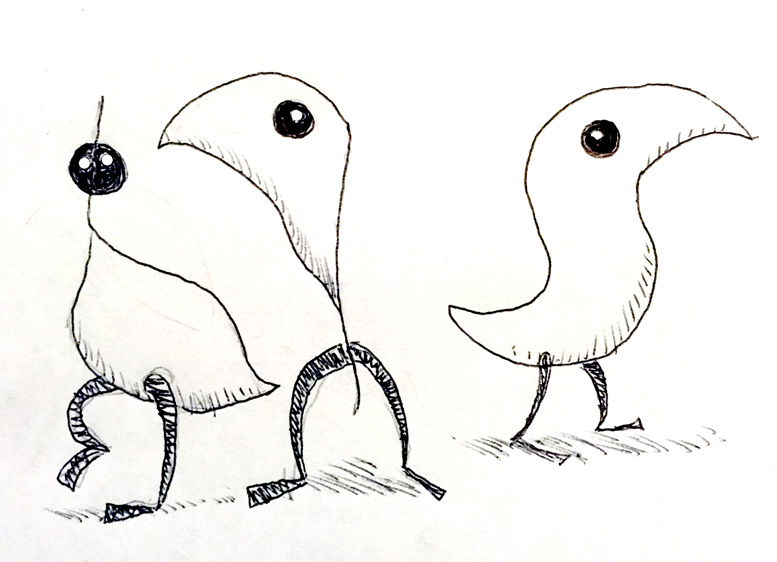
Nunce is the scarecrow who sits at the desk beside the Powers, transcribing their words into Animating Names. There are far too many scarecrows in the Valley for Nunce to deliver every name herself. Instead she passes the name off to her servants, the wugs, for delivery. The wugs resemble simple bird drawings- little more than a rounded body with two sticks for legs and the vaguest suggestion of a beak. The wugs are paper-thin and can float easily on the wind like fallen leaves, or slip under the door of a house.
(Wugs, by the way, were inspired by the Wug Test of Jean Berko Gleason, a psycholinguist who studies, among other things, language acquisition in children)
(Nunce’s original name was actually Nonce, a term for a word that is coined for a single use. Nonce is also, unfortunately, British slang for a pedophile, so I changed the spelling a little to distance the name from that connotation whilst keeping the same basic linguistic concept).
![]() |
| A couple of Wugs |
Hapax: Another scribe for the Autumnal powers alongside his sister, Nunce. But while Nunce takes words directly from the lips of the Autumnal Powers, Hapax- and his own army of wugs- scour the libraries of mankind to find mortal words to give character to the Animating Names. Sometimes he comes across written words that are known today only from a single use in a dead or forgotten tongue. Perhaps other references to the word are lost. Perhaps it was created for a single, special occasion. Whatever their origins, these single-use words have a particular potency. They are given to scarecrows of special import. Those who serve a key function in the River Valley. The scarecrows who guard the fields set aside for the dead, for example. Or scarecrows who inhabit fields marked by significant events, important battles, and geological anomalies.
![]() |
| Dwizzen and Cucupha |
Dwizzen: The story of Dwizzen is really the story of Elihu March and Thomas Steiner, two young men from farming families in the River Valley.
When Elihu was five years old, an accident left him paralyzed from the waist down. Though his father was compassionate, his brothers and children from neighboring farms mocked him relentlessly for his disability, calling him useless and a burden. One boy did not, though. Since he first learned to talk, Thomas Steiner struggled with a severe stutter that made even simple sentences difficult. He felt a deep kinship with Elihu and the two became fast friends.
In Thomas’ father’s field was a copse of trees used as a windbreak that the boys often used as a refuge from the mockery they endured on a daily basis. Thomas would carry Elihu to the trees in the early morning where the latter would spend the day with the books his father bought for him. At night Elihu would regale Thomas- and eventually some of the other farm children- with the things he had learned. He told them tales of the giant birds that had once roamed the Valley and left their fossilized footprints in the brownstone. He told them of the preacher who had tried to build a metal messiah. He told them of the great city to the west that was the center of the world where every language was spoken. He also helped Thomas work on his stutter by giving him poems and speeches to read slowly out loud.
One day Thomas and Elihu went out to their landlocked island after a strong nor’easter had blown through. Several trees had been knocked down and Elihu noticed that a small army of seedlings had sprung up on them. He’d read books on botany and was keen to study the new sprouts. Soon he noticed that the plants formed micro-environments on different parts of the fallen trees. The flora growing on top of the root-ball was different from the flora growing in the pit, which was different from the mosses, lichens and liverworts growing on the roots themselves, which were all different from the other plants in the copse. Elihu took careful notes on his findings and with the encouragement of his father and Thomas he submitted them to a botanist at the nearby college. To his surprise the professor wrote back, impressed with his work, and invited Elihu to give a lecture on his findings. Word of his research soon spread to other members of the faculty and to other universities of the River Valley. He received more offers to speak about his discovery and was soon making a regular lecture circuit. At first, he was carried into the halls on Thomas’ back, but soon one of the professors donated a wheelchair so the boy could get around easier.
Thomas and Elihu grew ever closer and soon their friendship developed into something more. When Elihu’s father passed away, the two of them moved into his old farmhouse together. They wed the next spring with a ceremony in the old copse of trees where they had spent so much time in their youth.
In time the expanding town bought up Elihu and Thomas’ land to make way for expansion. When the couple moved to a new farm, they took one of the old, tipped-over logs with them as a reminder of their home. Weathering and cracking had given the stump the rough semblance of a face, so Thomas and Elihu thought it would be only appropriate to give it a body as well. The log head was too heavy for the body to hold up, but as it happened, Elihu was looking to obtain a new wheelchair and gave the old one to the scarecrow, whom the Autumnal powers named Dwizzen.
Recently Dwizzen’s chair has been fitted with bicycle wheels to make it easier for him to navigate his fields. Like his human creators, Dwizzen is interested in the succession of plant communities. He has seen neighboring fields go fallow and give way to meadow then savannah then young forest. He often ponders what will happen when his own field is finally reclaimed by the land. Perhaps he himself will become the nursery for a new forest.
(The design and backstory for Dwizzen were inspired by the ecological concept of pit-and-mound topography.)
Cucupha: this scarecrow had been guarding his fields for many decades without anything very interesting happening. Until the day something finally did. One early spring morning, a group of strange men came to the fallow meadow adjacent to his cornfield. They worked for many days, on what exactly he did know, for the project was guarded day and night and he dared not approach close to see what it was. When they left at last, he crept to the meadow and discovered a giant arrow of poured concrete lying flat in the grass, pointing to the West. He spent many a night staring at it from the edge of his field, wondering what it could be for.
One day a strange bird flew over his field. It was larger than any bird he’d ever seen before. Its wings were stiff and dark. The creature did not have any feathers that he could see. Only smooth, white and gray flesh. It flew in a straight line, not swooping or banking like other birds. Cucupha was frightened by this odd creature, but he knew he had to do his job. He ran out into the open field, waving his arms to spook it. The bird did not cry out or swerve away as others did, but Cucupha’s efforts must have worked, for instead of landing to steal his crops, it continued on its way until it disappeared in the distance.
Things were quiet for a while after that. But a few days later another odd stiff-winged bird flew overhead. Again he ran out to spook the bird, and again it continued on its unwavering path to the west. Later that night another odd bird flew by, lower this time. And again he made a ruckus to scare it away. Then another the next day. And another. Soon there were strange birds flying overhead almost every day.
Where were all these avian aggressors coming from? It soon dawned on him that they had only started appearing after the men built that concrete arrow in the meadow. It must be some sort of beacon to the birds, he reasoned. Surely the men must have been jealous of his fields- the best fields in the River Valley- and had put up the arrow to summon the monster birds to devour his grain. But Cucupha would not allow that. He began to spend more time at the concrete arrow, waiting for the birds to come so he could chase them away.
When the farmer noticed Cucupha wasn’t in the fields anymore, he put up a new, non-living scarecrow. This didn’t bother the old scarecrow, though. Now he could devote more time to chasing off the monster birds.
In time the farmer moved away and the fields were left fallow. Meadow grass moved in to replace the grain. But Cucupha never noticed. All that mattered to him now was keeping the strange birds away.
By now readers may have figured out that the strange birds were actually airplanes. In recent years, the River Valley Postal Service has started using these new technological marvels to transport mail across the continent. The only problem is the long trips are difficult to navigate. While pilots can guide themselves by landmarks on short voyages, it’s all too easy to get lost on the long journey from coast to coast. To help their pilots, the Postal Service has erected a series of large concrete arrows all across the country. The markers are large enough to see from the air, and some are even lit up at night with torches. You can learn more about the Postal Service Arrows here.
Subscribe to:
Posts (Atom)