Saturday, November 19, 2022

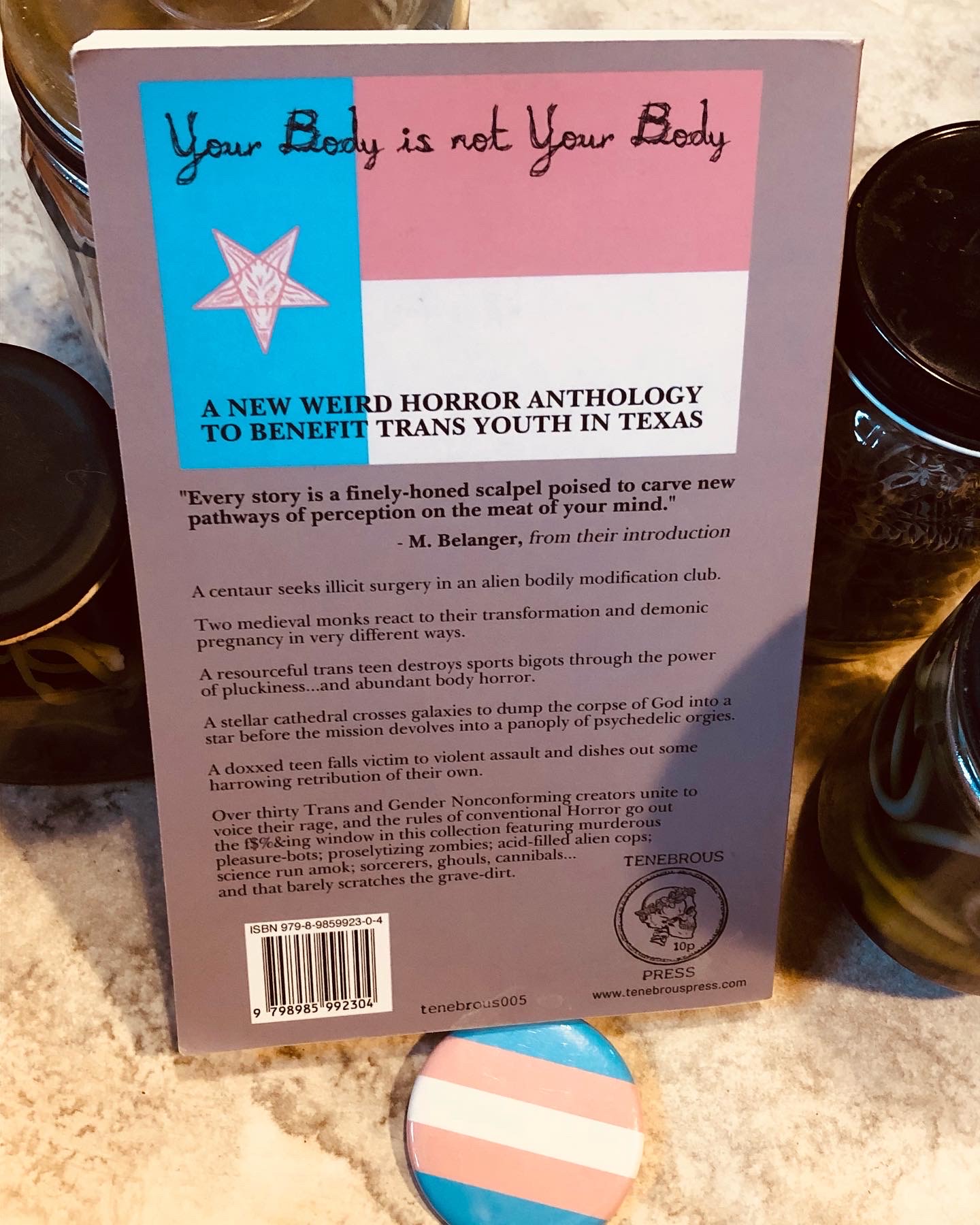
BOOK REVIEW: Your Body Is Not Your Body edited by Alex Woodroe with Matt Blairstone


I meant to post this book review back in October for Halloween, but I got super busy with class and work and couldn't get to it until now. But the cold and darkness of winter is still a fitting setting for horror, so here you go.

For some trans, nonbinary, and intersex folks, their body can become a kind of nightmare prison. Things feel wrong or off (though obviously, this isn’t true for every gender non-conforming person, and everyone expresses their gender differently). They might feel that their body is not in their control. And sometimes, even when they do start to take command of their own appearance and presentation, someone else tries to take that autonomy from them.

This anthology was created in response to the recent attempts by the Texas government to criminalize trans and gender non-conforming youth and their families. It is an angry cry and push-back against those who try to steal a person’s basic rights to their own body.  

The stories within explore all manner of body horror, existential dread, and bizarre imagery. There are medieval monks experiencing demonic pregnancies; A housewife baking up her own Frankenstein creature; a trans boy summoning Hellish powers so he can join the fencing team; a space cathedral carrying the corpse of God to inter in a dead star; high school girls holding in their frustration and anger until they literally explode; and even more bizarre, phantasmal sights.

Horror is about exploring the dark, often uncomfortable places of the human experience and these stories can get bloody raw, exploring themes of physical and emotional abuse, sexual assault, violence, and transphobia. I definitely had to put the book down a few times to take a breather. However, these stories are not meant merely for shock value or torture porn. They are catharsis for writers and readers both. A way of capturing and dragging the horrors out into the daylight. The edits are aware of how upsetting some of these tales can be, though, and have included an appendix of content warnings for each one.

Your Body is Not Your Body is also steeped in the genre of Weird fiction, defined as a mix of horror, fantasy, and sci-fi that is experimental, and often transgressive. Several stories play with the structure of narrative, occasionally breaking it down to the point that one may need to read a few times to figure out what is going on. Or maybe you’re meant to piece together your own explanation for what is happening. This may be a bit off-putting for readers who prefer a more linear horror narrative, but the stories run through many styles, and there is something everyone can appreciate.

Your Body is Not Your Body is available in paperback from Tenebrous Press.

Tuesday, October 25, 2022

BOOK REVIEW: The Old Snatchengrabber's Big Book of Child-Eating Monsters by Bitter Karella (writing as Mike Rosen)


Boogey-men, women, and those in-between abound in this collection of monstrous beings that live under beds, on the roof, or just on the edge of the forest path, waiting to grab and devour kids who misbehave or go to places they shouldn’t.

The Big Book ranges from familiar bogeys (at least to American pop culture) such as Rawhead Bloodybones, La Llorona, and Baba Yaga, to more obscure beings such as the Babylonian sewer-dwelling Sulak, the gossip-eating living marionettes called Croquemitaines, and the fungal witch Churnmilk Peg who punishes naughty children who steal unripe nuts from their neighbors’ orchards. All brought to life with Karella’s cartoony style.


Each entry is written in a field guide style with habitat, range, appearance, diet, and other vital statistics so you can identify the bugbear currently haunting your outhouse or crawlspace.  Looking through the entries, it quickly becomes apparent how hilariously gruesome boogeymonster folklore is, with monsters delivering punishments such as chopping kids to pieces; grinding them into sausage; suffocating them in piles of filth and sewage, ripping out their living guts and replacing them with stones, and other unpleasentries. I suppose if your kids won’t listen to reason, you gotta terrify them with the threat of dismemberment by a nightmare hag to get them to obey.


The Old Snatchengrabber’s Big Book of Child-eating Monsters is available as a PDF on Bitter Karella’s itch.io page, along with a bunch of other cool, spooky comics, books, and games- including the award-winning Midnight Pals!


Wednesday, October 19, 2022

BOOK REVIEW: Corpse Cold: New American Folklore by John Brhel & Joseph Sullivan with illustrations by Chad Wehrle


Another book review for the Spooky Season!

Corpse Cold is an anthology inspired by urban legends and folklore. These are stories your friends might tell around a campfire or on a late-night drive with only the headlamps and the green glow of the dashboard cutting through the darkness for miles around. These are stories that could maybe, possibly be true. Or, at least, they have that weird familiarity that makes them feel true.

Chad Wehrle’s nightmarish illustrations take clear inspiration from Steven Gammel’s work for the classic “Scary Stories to Tell in the Dark” series, though Wehrle’s own style clearly shines through.

The stories are often grisly- as folk tales usually are. Some, such as “A Morning Fog” and “Jesup” are cautionary tales. Others like “Moss Lake Island” and “It That Decays” are dark twists of fate. Several are based on modern fears like the dark web and “simulated burial” rides at amusement parks. Other tales, such as “The Black Dog” and “Czarny Lud” showcase timeless monsters that have existed for generations.


While not every story is memorable, there are no real bad pieces. Although “The Blue Hole” is a bit disjointed and isn’t helped by the accompanying illustration of a cartoonish soft-serve-style pile of fecal matter.

One of the cooler things about the book is the extensive appendix of notes at the end which explain the inspirations and background details for each story- another nod to Alvin Schwartz’s seminal “Scary Stories” books.

Fans of creepy urban legends, and those who grew up with the original “Scary Stories” books, will love Corpse Cold. You can get a copy of this book and others by these Brhel and Sullivan at Cemetery Gates Media

Wednesday, September 28, 2022

BOOK REVIEW: Neon Trash by MP Johnson


NOTE: the author of this book now writes under her true name Emma Alice Johnson)

I love doing book reviews, so for the upcoming spooky season I thought I’d tackle a couple of my recent favorites, starting with this short little karo syrup-blood covered gem.

Neon Trash is a fictional tribute to bad movies. Not Hollywood bad- as the author makes very clear in her introduction- but shoestring-budget bad. The grimiest films from the golden age of VHS, made outside the big studios and often done by people with little directing experience. Films overflowing with tons of cheap liquid-latex monsters, cartoonish gore, and gratuitous nudity.  The bizarre movies one finds in catalogs at the back of yellowed fanzines moldering in cardboard boxes in a comic shop basement. Movies that showed once in a cheap downtown theater with sticky floors, then went straight to bootleg tapes with static, bad tracking, and lurid titles written on the side in Sharpie. Titles like “Meatface Massacre”, “One More Cannibal”, “Werewolf Beach Party”, and that ultimate of trashy 80s treasures- “Neon Meltoids”.

Most of the book is a “guide” to these fictitious films, summarized with delightfully gross and crass descriptions. The names and plots may be entirely made up, but they definitely capture the feel of vintage schlock horror. And as Johnson explains, just reading the weird summaries of such trashy films is often the best part.

The book also includes fictional interviews with some of the scream queens, weirdo actors, deranged directors and other staff of these monstrosities. There’s even a narrative story by Johnson about their quest to find a rare VHS tape of the quintessential 80s trash flick, “Neon Meltoids”. 

The adventure doesn’t go well…

BUT the book does end with a special treat for collectors- a partial script of a previously lost scene from the titular film.

At only 60 pages, Neon Trash is a super-quick read that perfectly encapsulates the feel of grody 80s garbage horror. It appears to be currently out of print, but hopefully Johnson will re-issue it soon. In the meantime you can find used copies on Amazon

And find more stuff by Johnson on her website


Thursday, January 20, 2022

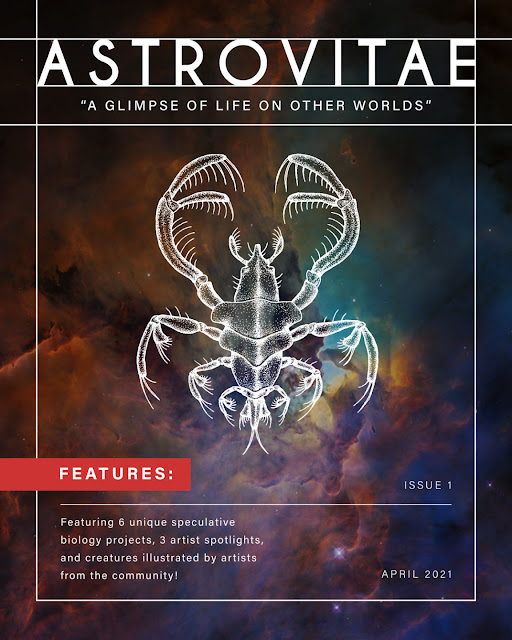
Astrovitae magazine: "A glimpse of life on other worlds"


Astrovitae is a magazine of speculative biology. But what is that, exactly? Speculative biology is, in many ways, a hybrid genre. It is fictional life- animals, plant, microbe, and other organisms- designed with a deep grounding in the laws and constraints of biology and physics. Now of course writers and artists have been inventing imaginary creatures since the dawn of human history. But many of those are rooted in myth and fantasy. Creatures of speculative biology, however, are grounded more in science- though even then the degree of realism can vary.

 The modern incarnation of speculative biology has its origins in the 1970s and 80s with Dougal Dixon’s After Man- a fictional field guide to Earth life millions of years in the future; and with artist Wayne Barlowe’s Expedition, a visual voyage to a fictional alien world. Later works such as the Speculative Dinosaur Project; C. M. Kösemen;s Snaiad project and his novel of future human evolution, All Tomorrows; and the early 2000s pseudo-documentary series The Future is Wild also served as major inspirations for many students of speculative biology. Many of these amateur artists and writers built their worlds in relative isolation during the 90s and early 2000s, but the increasing communication afforded by the internet allowed them to connect with each other more easily, resulting in a boom in creative output.

 Astrovitae magazine, founded and edited by Domenic Vincent Pennetta, aims to gather works from many of the spec bio creators working today to showcase the diversity in the genre. The majority of the entries in this first issue feature extraterrestrial life- particularly aquatic extraterrestrial life- though there a few organisms derived from our own Earthly fauna. This may simply be due to the interests of many artists working right now, but hopefully future issues will be able to feature more speculations on the possibilities of Earthly life.

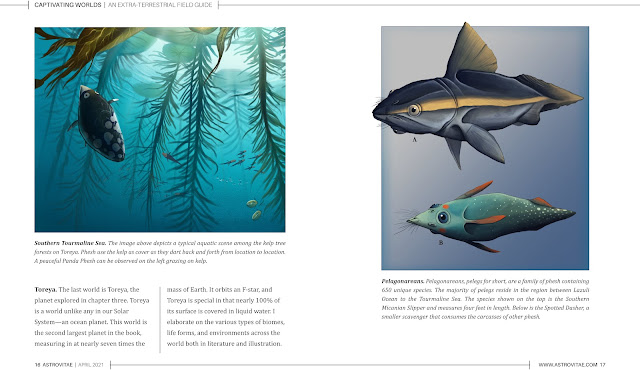
A couple of aquatic aliens designed by Christian Cline

The magazine is divided into three sections. Captivating Worlds offers glimpses into several world-building projects- a brief peak at a kaleidoscope of planets. Artist Spotlight focuses on the artists themselves and the ways they develop and design their worlds. Creature Compendium is a showcase of individual organisms as opposed to full ecosystems.

 If you’re a biologically-minded person like me, it’s fascinating to see how each artist has used the known ecological and physiological laws of our own planet to extrapolate their creatures. Their organisms are alien, yet convergent evolution creates an undeniable familiarity. These worlds may not be ours, this life not the kind we know, but they undeniably evoke familiarity. A reader can see how these creatures fit into their ecology and how the have been shaped by the same biological and physical laws that have molded our own ecosystem.

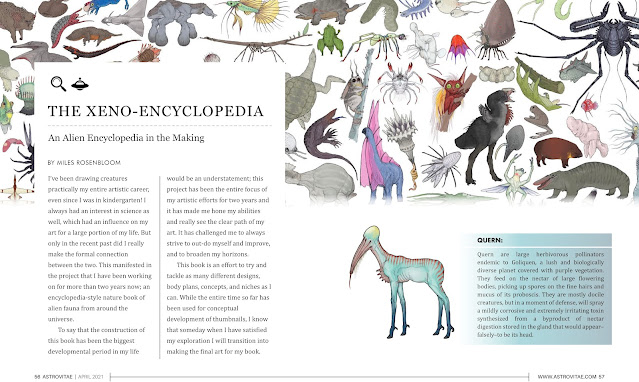
A menagerie of strange beasts envisioned by Miles Rosenbloom.

It is also interesting to see the range of approaches to presenting these speculative organisms. Some artists like Christian Cline and Veknor showcase their worlds like a “field guide” or an informative plaque that one might find in a museum. Others like Reinhard Gutzat and Miles Rosenbloom focus on the aesthetics of creature design, presenting their works more like medieval bestiary or, if you’re a fan of TTRPGs, like the entries in a Monster Manual.

 I appreciate that most of the organisms have been given a common as well as a scientific name. While the latter adds to the realism, the former gives the organism more character for a reader to hook onto.

 This first issue of Astrovitae is a satisfying initial glimpse into the diversity of speculative biology creators working today. I’m eager to see what future issues will bring. You can download the first issue free on the official website.


Thursday, April 8, 2021

Art History, Part 3: Another Speculative Radiodont


Another speculative radiodont lost to the fossil record (check out my first entry here). This is the False Ammonite, Pseudammonites ptilobrachiones, a filter-feeder that sweeps plankton and small fish from the water with its massive, broom-like Great Appendages. Much like a hermit crab, the creature’s soft body is protected inside the discarded shell of another animal, in this case an ammonite. The False Ammonite’s home floats at the surface of the ocean thanks to a symbiotic siphonophore, Megaera deformibaccata,  that inhabits the inner chambers. Siphonophores are relatives of jellyfish that form vast connected chains of individual animals known as zooids. Many zooids are highly modified to serve specific tasks within the colony such as reproduction, prey-capture, and bouyancy. The striped, pink tentacles dangling from the aperture of the shell in this illustrations are Megaera’s fishing tentacles and the orange pear-shaped blobs are gas-filled "float" zooids.

To the right of the False Ammonite is another hypothetical filter-feeding radiodont, the Sun Drifter, Medusocola silvadorsum. Drifters inhabit the stomachs of jellyfish, where they gain protection and free transportation. Most Sun Drifters harbor a small colony of Gardner Crabs, Demeter hortulanus. These crustaceans feed on algae that they cultivate on the back of their Drifter. Like a human gardener, they constantly tend and prune their harvest, brushing it clean with their furry antennae and keeping it free of other herbivores.

Those strange, vertically-oriented creatures are Thief Fish, Scutoculus longinares. They hang out under the False Ammonite, using their large, fan-like tail fins to keep themselves upright so they can steal bits of food from the great appendages of the radiodont and from the tentacles of its siphonophore partner. Thief fish have transparent bubbles of hard skin covering their eyes to protect them from the fine, stinging hairs that cover the False Ammonite’s arms and from the jelly’s tentacles.

Visually this piece was inspired by a painting in the book The New Dinosaurs by Dougal Dixon, a Scottish paleontologist and educator. The New Dinosaurs postulates what dinosaurs, pterosaurs, ichthyosaurs, and other Mesozoic animals might have revolved into had they not gone extinct at the end of the Cretaceous.  Dixon had written an earlier book, After Man, about how animals might evolve millions of years in the future after humans have gone extinct. After Man and The New Dinosaurs (along with Dixon’s less popular Man After Man, about the possible future evolution of humans) are considered by many to be the foundations of the modern genre of speculative evolution.


The entry that influenced my creature was the Kraken, Giganticeras fluitarus, a massive speculative ammonite that feeds with nets of stinging tentacles much like a jellyfish or siphonophore. 


The Thief Fish were inspired by the real life Barreleye Fish, Macropinna microstoma, an unusual deep-sea fish that has elongated eyes which can rotate straight up to scan the water above it. It is thought that the barreleye feeds by stealing food from the tentacles of siphonophores, deep-dwelling relatives of jellyfish. Live footage of Macropinna revealed that the fish has a transparent shield over its eyes which may protect them from siphonophore stings.

Barreleye. Image Courtesy: Wikimedia Commons

The Sun Diver was inspired by Phronima, a genus of crustaceans that ride around in the hollowed-out gelatinous bodies of barrel-shaped creatures called salps. While Phronima eats the insides of its host, leaving just an empty, protective jelly-shell, the Sun Drifter leaves its host alive, to serve as a living transport.


Thursday, February 4, 2021

Art History, Pat 2: Microbes


 Here’s another illustration inspired by the former Ruthven Museum, now the University of Michigan Museum of Natural History. This piece was inspired by the Pond Life diorama on the Ecology and Wildlife floor.

Life in a drop of water.

Rotifers

Algae and ciliates

A colony of Volvox and more microscopic algae.

I’d seen pictures of microbes before, but this diorama really got me to think about them as actual living organisms with unique niches in a functioning ecosystem. I imagined them as animals in a real world rather than just weird phots and drawings.

There is incredible diversity in microscopic life. The most prominent and photogenic critters, of course, are the adorable water-bears, and wheel-mouthed rotifers. But there are tons of strange, interesting living things that all tend to get mushed together under the blanket “Protists” or “Protozoa” label. Microbe classifications are constantly changing, but at present there are around seven major groups that include Euglenids, amoeba, ciliates, flagellates, and so on.

It's tempting to think of microbes as alien creatures. I have, in fact, used protozoans as inspirations for extraterrestrials in other art projects. But the truth is microscopic life is far more abundant on Earth than animals, plants, and other large organisms. They've been around a lot longer too. Life on Earth was primarily microscopic for about three-fourths of its history. It's only within the last billion years or so that macroscopic life evolved on our planet. So, really, WE are the alien newcomers (geologically-speaking) on their world.

By the way, you can get a print of this piece on my store.