Monday, May 22, 2017

Triassic Fossils of the East Coast: The Long-Necked Reptiles

Here's another article I wrote for the Spring 2017 issue of Tracks and Trails, The Dinosaur State Park newsletter.

First a little introduction. In the Connecticut Valley, the majority of fossils are trackways. Bones and body fossils of large tetrapods are quite rare with a few exceptions such as the partial remains of Podokesaurus, a Coelophysis relative found near Holyoke, Mass, and the hand and hip bones of the early prosauropods Anchisaurus and Ammosaurus (there are, however, abundant full-body fossils of Jurassic fish, but that's an article for another time).

Tetrapod bones have, however, been found in a number of other Triassic-Jurassic rift valleys along the East Coast. Since these valleys all date from the same time period- during the break-up of Pangea- it is highly likely that these creatures also inhabited the Connecticut Valley.

There are a lot of interesting fossils along the Atlantic Coast, but I only had so much space for the article. So I decided to spread it out into several pieces covering groups of related animals.  This first article talks about the Tanystropheids, a diverse group of reptiles with unusually long necks.

I also did a couple black-and-white illustrations of the creatures I talk about. It's nice to finally be getting back to some paleoart after such a long hiatus.

Anyway, without further ado:


TRIASSIC FOSSILS OF THE EAST COAST: THE LONG-NECKED REPTILES
by John Meszaros

The Triassic period can be thought of as a time of “evolutionary experimentation”. The preceding Permian Age ended with a massive extinction event- the largest known extinction in Earth’s history, in fact- that wiped out ninety percent of life on Earth. In the wake of this Great Dying, innumerable ecological niches were left vacant. Life evolved to take fill these gaps, often in forms that seem bizarre to us in the modern day.

Although evidence of Triassic life is rare in Connecticut, fossils from other sites along the East Coast of North America allow us to construct a reasonably accurate picture of the animals that would have lived here. Dinosaur State Park’s Triassic diorama and its accompanying background painting by William Sillin depict a few of these prehistoric creatures: the crocodile-like Rutiodon; the giant amphibian Metaposaurus; bearded dragonesque Hypsognathus; pig-nosed Stegomus and the early dinosaurs Coelophysis and Sileasaurus. These are but a small sample, however, of the unique and unusual Triassic beasts lying buried in rocks all along the Atlantic coast.


One of the more distinctive reptiles of the Triassic was Tanystropheus (Greek for “long vertebrae”). Sometimes described as a “living fishing pole”, this creature was characterized by its extremely long neck- at 10 feet, it was longer than the rest of the animal’s body and tail combined. Despite this length, however, Tanystrophus's neck had only 12  elongated vertebrae. The exact reason for this strange anatomy is not known, but since fossils of Tanystropheus are usually found near marine sediments, it is speculated that the animal hunted for fish from the shore by dipping its head and neck into the shallows.

Tanystropheus bones are known primarily from Europe, the Middle East and China. However in 2014 paleontologists Paul Olsen and Hans-Dieter Sues described the discovery of a single Tanystropheus neck vertebra from the coast of Nova Scotia along the Bay of Fundy, thus establishing the presence of these reptiles on our side of the Atlantic. This is actually not that surprising considering that during the Triassic the lands that would become North America and Europe were close together within the super-continent Pangea.   


In contrast to the single Tanystropheus bone from Nova Scotia, fossils of its smaller cousin, Tanytrachelos, are abundant
in fossil sites along the East Coast- primarily in the Solite Quarry of Virginia. Nine-inch long Tanytrachelos resembled a long-necked lizard with powerful webbed hind legs that it used to kick-swim in a frog-like manner through the shallow lakes of the Triassic rift valleys. It likely fed on aquatic insects, which are themselves abundantly preserved in fine detail at the Solite Quarry.

Tanytrachelos is thought to be the maker of a type of fossil footprint called Gwyneddichnium, found abundantly in Triassic sandstones from Pennsylvania. It is, of course, not possible to determine exactly what creature made these tracks- just as it is not possible to say definitively that Dinosaur State Park’s own Eubrontes tracks were made by Dilophosaurus. However, the foot structure of Tanytrachelos is a close match to Gwyneddichnium, making it- or a very similar reptile- the most likely candidate.


The same Virginia quarry where Tanytrachelos fossils are so abundant has also yielded fossils of another possible Tanystropheus cousin, the gliding lizard Mecistotrachelos . This creature lived among the boughs of the ancient forests, hunting insects and sailing from tree to tree on wings formed from elongated ribs much like those of the “flying lizard” Draco volans of South-east Asia.
Mecistotrachelos shared the Triassic skies with a number of similar wing-ribbed gliding reptiles, including Kuehneosaurus (known from fossils found in southwestern England) and Icarosaurus (known from a single specimen unearthed in New Jersey). It differed from these other gliding lizards in a few ways. For one thing, it had an elongated neck similar to Tanystropheus- though it’s neck was much less exaggerated than the “fishing rod” of the latter animal Mecistotrachelos also appears to have had better maneuverability in the air than its contemporaries. The base of the first wing-ribs were significantly thickened- much thicker, in fact, than the leading ribs in other gliders. This suggests that they may have been anchors for strong muscles that would have allowed the creature to flex its wings, giving it the ability to bank and alter its direction as it descended. 

Mecistotrachelos is notable for being the first fossil to be analyzed with a CT scanner- a necessity since the skeleton was too delicate to be removed from its stony grave through typical paleontological procedures.

Though none of the species  discussed here have yet been found in the Connecticut Valley, as was said before, the presence of these fossils in other East Coast fossil Triassic river valleys gives good evidence that frog-like Tanytrachelos once swam the waters of our state in the shadows of the predatory phytosaurs whilst wing-ribbed Mecistotrachelos glided through the gingkos and conifers along the shores. And where the rivers met the sea, it is quite possible that there were Tanystropheus dipping their fishing-pole necks into the surf to snap up fish.   

REFERENCES

Window Into The Jurassic World by Nicholas G. MacDonald

Dawn of the Dinosaurs: Life In The Triassic by Nicholas Fraser, illustrated by Douglas Henderson

The Great Rift Valleys of Pangea in Eastern North America: Sedimentology, Stratigraphy and Paleontology (Volume 2) edited by Peter M. LeTourneau and Paul E. Olsen

Last Days Of Pangea: In The Footsteps Of Dinosaurs by Daniel T. Ksepka and Kate Dzikiewicz
(This is a slim informational booklet to accompany an exhibit on Triassic fossils at the Bruce Museum in Greenwich, CT)


Quantitative Taphonomy of a Triassic Reptile: Tanytrachelos ahynis from the Cow Branch Formation, Dan River Basin, Solite Quarry, Virginia. Michelle M. Casey. Master's Thesis in Geosciences. 2005 Virginia Polytechnic Institute and State University

Stratigraphy, Sedimentology and Paleontology of the Upper Triassic Solite Quarry, North Carolina and Virginia. Cynthia M. Liutkus-Pierce, Nicholas C. Fraser and Andrew D. Heckert. Geological Society of America Field Guides 2014; 35; 255-269

Stratigraphic and Temporal Context and Faunal Diversity of Permian-Jurassic Continental Tetrapod Assemblages from the Fundy Rift Basin, Eastern Canada. Hans-Dieter Sues and Paul E. Olsen. Atlantic Geology 51; 2015; 139-205 


Friday, May 19, 2017

Review: Ghost Machine: A Gothic Steampunk Novel by Kristen Brand


(The author sent me a free copy of this book in return for an honest review)

The combination of Gothic and Steampunk isn’t as unusual as one might at first think. The genre of science fiction actually has its origins in the early gothic pulps, many of which incorporated scientific elements in their plots. See, for example: Frankenstein; Dracula; The Strange Case of Dr. Jekyll and Mr. Hyde; Poe’s novella “The Facts in the Case of M. Valdemar” and so on.

Ghost Machine begins in that most gothic of locals- an isolated asylum ( in Transylvania, no less! Though, there are no vampires to be found). Ella Rosenfeld has been brought to Auttenberg Asylum by her parents to cure her of the visions she’s been suffering from ever since she was caught in an accident involving her father’s automata creations. Ella is having hallucinations of ghosts, you see.  Well, she and her family would like to believe they’re only hallucinations. But Ella soon realizes the unquiet spirits she sees are quite real. And, unlucky for her, the head psychiatrist of the asylum, Dr. Grünewald, fully believes in her abilities too and furthermore intends to turn her into his prized test subject whether she is willing or not. After enduring several days of the doctor’s excruciatingly painful experiments, Ella escapes and manages to make it to the castle of Baron Szarka, a local noble and her inventor father’s current benefactor. But Dr. Grünewald will not let Ella go that easily and soon comes after her with a small army- including a gigantic iron war automaton (a surprising technological marvel for a seemingly ordinary medical doctor to have at his disposal...)

Ghost Machine starts off as a mostly gothic story with little dashes of Victorian “mad science” here and there. But as the novel progresses the steampunk elements become more pronounced, including the appearance of lightning guns, flying metal giants and that classic of the genre- airships. Brand seamlessly melds both genres together in her tale, and indeed supernatural and super-science eventually come together in an excellent denouement.

I really like the character of Ella Rosenfeld. Despite all the danger and pulpy action happening around her, she never feels like an unrealistically over-the-top “badass”. She is, rather, a very real normal young woman surviving a dangerous situation through resourcefulness and not a little bravery.

I appreciate that injury is handled realistically. A quarter of the way through the book, Ella’s foot is severely frostbitten and the pain and risk of infection continues to plague her throughout the rest of the story, though she does her best to deal with it.

I also appreciate that, although Grünewald and his staff are cruel and corrupt, the book portrays institutions for the treatment of mental illnesses as essentially good and positive places if they have genuinely compassionate administrators. 
  
 Ghost Machine is a great blending of gothic and steampunk that will please fans of either genre. You can get a copy on Amazon

And check out Kristen Brand's website here.


Monday, May 8, 2017

Edward Hitchcock: The founder of ichnology

Since I started working at Dinosaur State Park in Rocky Hill, CT, I've learned a lot about the history of paleontology in Connecticut. A lot of milestones in the study of ancient life happened right here in the Nutmeg state, not the least of which is the founding of the Yale Peabody Museum which houses many of the spectacular finds of Othniel Charles Marsh.

But another great contributor to the study of ancient life was Edward Hitchock, a professor at Amherst College who did the first scientific study of the dinosaur footprints that are abundant in the Connecticut Valley.

For the Winter issue of Dino State Park's newsletter, Tracks and Trails, I wrote a brief biography of Hitchcock in the hopes of exposing this paleontological pioneer to a wider audience.

Here's the article in its entirety (I should add that this article was written to accompany another series of articles talking about a lecture series by Dr. Robert Bakker, who came to Dinosaur State Park as part of our celebration of the 50th anniversary of the discovery of the tracks):

A bust of Edward Hitchcock at the Bekinski Museum at Amherst College in Massachusetts

EDWARD HITCHCOCK: DISCOVERER OF THE TRACKWAYS

by John Meszaros

In his guest lecture to the Geological Society of Connecticut, Dr. Robert Bakker talked about the achievements of renowned geologist Edward Hitchcock. But just who was Hitchcock, exactly?

Born to a farming family on May 24th, 1793 in Deerfield, Massachusetts, Edward Hitchcock was fascinated by the natural world from a young age. He spent his free time during the day engaged in scientific pursuits, and his nights outside lost amid the stars.  This nascent naturalist was, however, stricken from the beginning with poor health, often suffering from “dyspepsia”- acute problems with indigestion coupled with feelings of anxiety and depression. In 1814 he was even temporarily blinded by a severe case of mumps. Nature brought the young Edward solace from his maladies. He would often take long hikes in the mountains surrounding Deerfield, a habit that would instill in him a deep fascination with the natural history of the Central Connecticut Valley.  This fascination would continue into adulthood and eventually lead to his position as one of the foremost geologists in New England.

Young Hitchcock wrote multiple papers on his observations and submitted them to the American Journal of Science, one of the first publications in America exclusively devoted to science. Thanks to these papers, Hitchcock gained a reputation among scientific circles that would eventually lead to the Trustees of Amherst College inviting him to take the position of Professor of Natural History and Chemistry. In this position he continued to make geological discoveries, including the realization that the basaltic ridges so prominent in the Connecticut Valley were formed from magma pressing up through fissures in the crust rather than exploding out of volcanoes. His most well-known discovery came around 1835 when he saw the first of the dinosaur tracks that would become his life’s work.

The trackway discovered by Pliny Moody in 1802. It was nicknamed "Noah's Raven" in reference to the raven that was initially released by Noah to find land after the Deluge in the Bible. The tracks are taxonomically identified as Anomoepus, and were probably made by a small ornithiscian dinosaur similar to Scutellosaurus. Currently on display in the Bekinski Museum.


Some weird dork posing with the tracks.

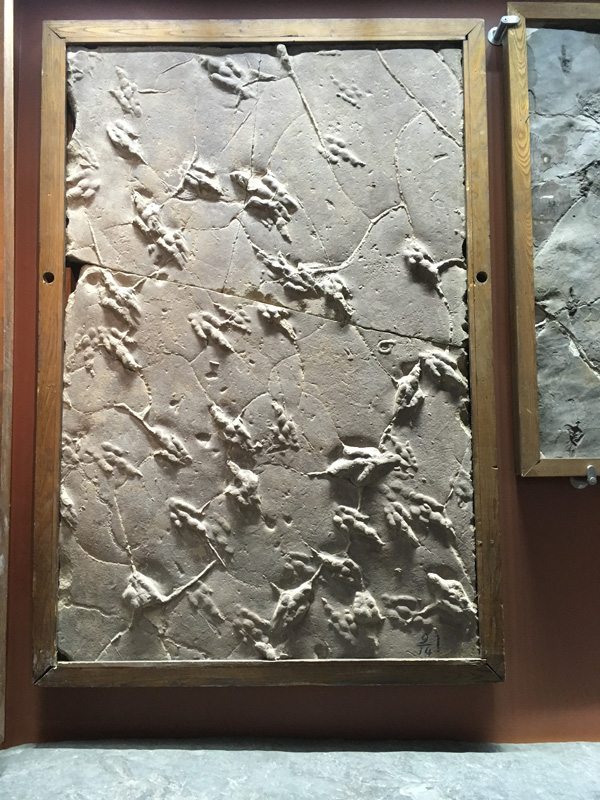
People living in the Connecticut Valley had long been aware of the strange footprints embedded in the red sandstone all around them. The first recorded evidence dates from 1802, when a teenager named Pliny Moody made a doorstep out of a large track-covered slab that he dug out of his father’s field.  Hitchcock, however, was the first person to make a formal scientific investigation of the tracks. He learned of the prints via a physician named James Deane, who had heard of them himself from a man who, much like Moody, had used a slab of trackway as a paving stone in front of his house. Once Hitchcock got a look at the tracks himself, he began a search up and down the Valley, hunting for more of the mysterious fossils and finding them everywhere- in quarries and eroded hillsides, in manmade walls and laid flat inside walkways.  After collecting dozens of track-bearing sandstone slabs, Hitchcock began a long, comprehensive study of the prints, eventually developing a new science, Ichnology, which is the study of animal behavior through traces such as footprints, burrows, droppings and so on.

The term “dinosaur” did not exist at the time that Hitchcock was studying the Connecticut tracks. It would be several years before anatomist Sir Richard Owen would formally introduce the term. Hitchcock, therefore, hypothesized that the prints had been made by gigantic moa-like birds- and to a lesser extent by strange prehistoric frog- and marsupial-like creatures. Even when dinosaurs became widely known, he clung until the day he died to the idea that the mystery print-makers were great birds rather than Terrible Lizards.  The exact reasons for his stubborn attachment to enormous avians as the culprits is unclear.  But it is an amusing irony that within the past few decades the old model of dinosaurs as lumbering, rotund reptiles has been discarded in favor of images of swift, active, feathery creatures much more closely related to birds than lizards.

A spectacular example of the ichnogenus Grallator from the Bekinski Museum. These may have been made by Podokesaurus, a Jurassic relative of Coelophysis whose fossils have been found in the Connecticut Valley.

To fully understand Hitchcock, it’s important to know that he was as much a man of faith as of science. He was a devout Christian and considered himself a scholar of Natural Theology- the study of Nature in an attempt to better understand God. He scorned the works of Lamarck and Darwin which advocated for evolution and natural selection, preferring instead the idea that God had created and then destroyed several sequences of animals perfectly adapted to their environment. Like many of his fellow natural theologians, though, Hitchcock did not take the word of the Bible literally. He viewed many passages as metaphor or interpretation and worked diligently throughout his life to bridge the words of Scripture with his scientific observation.

Hitchcock's "Stone Book", made from several layers of sandstone slabs held together with iron staples. Designed to illustrate how a dinosaur stepping into soft mud could leave footprint impressions on several layers. From the Bekinski Museum.


Though Hitchcock was in many ways a man of his time, there was at least one area where he was socially ahead of his contemporaries. At a time when higher education was considered unfit for women, Hitchcock tutored many of them in his classes. Among his students were the poet Emily Dickinson- who often included scientific terms in her works- and Mary Lyon, the founder of Mount Holyoke College (which was known at the time as a Women’s Seminary). Lyon, especially, was a close friend of Hitchcock and his family and would often live with them for several months at a time. Upon Lyon’s death Hitchcock wrote “A Chapter in the Book of Providence”, a tribute to her life that he later expanded into a full biography, The Life and Labours of Mary Lyon.

Another remarkable woman in Edward Hitchcock’s life was his beloved wife Orra White who was, for a time, an assistant teacher at Deerfield Academy. She was also an accomplished watercolor artist and created hundreds of illustrations for her husband’s writings and lectures. In the dedication to his book The Religion of Geology, he wrote that “your (Orra’s) artistic skill has done more than my voice to render that science attractive to the young men whom I have instructed.”

Edward Hitchcock’s work on the Connecticut Valley trackways has left an indelible mark on paleontology and New England geology. At Dinosaur State Park you can view two of his classic footprint studies alongside a replica of “The Bones From the Well”, one of the few dinosaur skeletons found in Connecticut. You can also see Hitchcock’s complete collection of fossil footprints in a special dedicated gallery at the Beneski Museum of Natural History in Amherst, Massachusetts.

You can learn more about Hitchcock from the book Curious Footprints: Professor Hitchcock's Dinosaur Tracks & Other Natural History Treasures at Amherst College by Nany Pick and Frank Ward 

Brendan Hanrahan also gives a good summary of the life of Hitchcock and other significant Connecticut Valley paleontologists in his book Great Day Trips in the Connecticut Valley of the Dinosaurs

A view of the Edward Hictchcock Trackway Room at the Bekinski Museum. Seriously, if you ever get the chance, go see this place.


Another view of the track room.

A really cool fossil of the Anomoepus trackmaker sitting down. You can see the elongated ankle stretching out behind the prints, and even the impression of the pubis bone at the bottom.


Saturday, February 11, 2017

Review: Legacy by Wilde Blue Sky


First, a little warning. I didn’t want this review to turn into a political rant, and I have refrained from soap-boxing or calling names. But Legacy is a socially- and politically-charged novella with many chilling parallels to recent developments in the world (I’m writing this in January 2017). At several points the neo-Nazi protagonist, Peter, even says “I will make Germany great again!”; This novel was written in 2012, by the way, so the similarity to a certain right-wing rallying cry is coincidental but frightening. Legacy is primarily an alternate history story, but I believe it would be disingenuous to pretend that it is not also a social commentary in the vein of 1984 or The Grapes of Wrath.

The events move swiftly, painting a grand panorama of the life of Peter, the secret son of Adolf Hitler and Eva Braun, as he rides a wave of neo-Nazi nationalism towards possible control of a post World War II Germany. The four co-conspirators who set the novel in motion are bitter and vindictive. Germany’s defeat by the Allies is a wound that has never closed up for any of them. They believe that that genetic “right” of the pure-blooded Aryan people to lead Germany has been stolen from them. Thus they turn to Peter, manipulating his fears of alienation and worthlessness to push him into becoming the charismatic figurehead for their movement. 

There is little subtlety to the dialogue. But then, there is little subtlety to the anger and fear that drives the sort of xenophobic nationalism this story warns of. The story reminds me, in style if not content, of the works of Fyodr Dostoyevsky such as White Nights or Notes From Underground. Like those works, the characters of Legacy broadcast their thoughts front and center through dialogue and private musings

I was struck by the few hints at Peter’s particular disgust for homosexuality. In general, the characters are painted in fairly broad strokes. They are mouthpieces for the plot. Thus this little glimpse into Peter’s psyche stood out to me, even though it was a relatively minor component to the overall story. There is a particularly poignant scene where a young grieving man reaches out to Peter for support, only to be rebuffed by his apparent discomfort with expressing compassion. I wonder if this is meant as a jab at the fragile hypermasculinity and homophobia that often accompanies hard-line nationalist movements, both right and left. This is particularly tragic in Peter’s case because one can see his own need for companionship- as well as a desperate need to feel like his life is worth something- glaring through the cracks of his hard shell. 


In the end, Legacy is a fast-paced and straightforward alternate history tale. But its clear warnings against nationalism and fear-mongering are potent and disturbing. You can get from Amazon.

Horror Book Review: The Cat-Dogs, edited by A. Finnis


Way back around Halloween 2016 I’d planned on doing a whole month of reviews on my favorite scary story collections that I’d read as a kid. Life got busy and I only got to one, so I figured I’d just continue on into November (autumn’s a pretty spooky season in general, so it’d still somewhat fit, right?) Welp, life got in the way some more and I only got to one other anthology. At this point I could just wait until next Halloween and try again... but heck, I like reading scary story anthologies. So I’ll just plow ahead with some more reviews and find something else for Halloween 2017 (because you know it’s going to be something big, considering how much I love the holiday).

The Cat-Dogs is one of the more unusual, dream-like anthologies I’ve read. The horrors in these stories aren’t clear-cut ghosts, werewolves, vampires or other conventional monsters. Each story in the anthology is written by a different author, and thus each has a slightly different tone. Based on the majority of the settings, it seems like this anthology originally came from the U.K.

The Cat-Dogs
by Susan Price

The titular story is about a girl, Liz, who finds an abandoned litter of odd baby animals and brings them home to her parent’s farm on an old English estate. The animals are something like felines and something like canines- hybrids, somehow. Biologically impossible, of course, but this is horror, so who’s paying attention? As the cat-dogs get older, they get more and more vicious and eventually murderous. The story climaxes with a slow, suspenseful chase through the dark woods as Liz and her father try to hunt down the creatures before they can cause any more death. And of course they’re being stalked themselves. A very simple- indeed, one of THE most basic horror plots- but done very effectively.

The Piano
by Diane Hoh

This one feels like a dark fairy tale. A teenage girl, Laura, is forced by her cruel stepmother to practice the piano for hours so that she can win a contest that will allow said evil stepmom to live in luxury. As Laura sits at the bench complaining to herself, the piano actually responds. It communicates through snippets of songs: “Black-hearted Woman”, “Why Do Fools Fall in Love?”, “Let It Be” and so on. Laura is surprisingly unfazed by this, which adds even more the fairytale logic of the story, and quickly develops a close bond with the supernatural instrument.  Then people that Laura hates start dying in bizarre accidents, which the story implies is being orchestrated (ha!) by the piano... somehow. 

 I’m pretty impressed that the author was able to create entire dialogues between Laura and the piano with the instrument only using the titles of songs. I like the fact that there is no explanation for what the thing actually is. Maybe it’s haunted? Maybe it’s alive? Maybe it’s like the car from Stephen King’s “From aBuick 8”- it only looks like a piano, but is actually something completely alien.


The Devil’s Footprints
by Malcolm Rose

A story set in the future world of 2004 (the book came out in 1994) where a rich kid named Darren throws a huge Halloween party at his technologically-advanced house while his parents are out of town. Seeing as how this is a horror anthology, you know someone is going to show up to kill all those dumb, unsupervised teenagers. And seeing as how the story is called “the Devil’s Footprints” you can probably guess who.

The interesting thing about the story is that it’s inspired by a real supernatural phenomenon that occurred in England around East and South Devon. Residents of the area awoke one cold February in 1855 to find eerie horseshoe-shaped prints running everywhere through the new fallen snow. In many places the prints seemed to defy normal physics. They would go right up to high stone walls, over the top, then continue on the other side. Other prints would go up to the walls of two-story houses, and immediately continue on the roof.

The future setting is a weird addition, though it seems that it was done so that the house could have an intelligent A.I. program that can’t record the Devil on any of its cameras to heighten the supernatural nature of the part-crasher.

Softies
by Stan Nicholls

One of the most bizarre stories in the anthology. The main premise is that everyone on Earth has a human-sized, sentient stuffed animal as a permanent Companion that follows them everywhere and always keeps them company. Problem is, despite being clearly intelligent beings with their own individual personalities and wants, Companions are treated as little more than slaves and property. And they’re not very happy about that...

So yeah, it’s a horror version of “Ted”

The premise sounds goofy, but there is something weirdly sinister and creepy about the tale. Maybe it’s the imagery of giant, sentient stuffed toys having dark thoughts of revenge. Like The Piano, it creates a grim, very fairy tale feeling.

The House That Jack Built
by Garry Kilworth

This one was my favorite of the bunch. The story that stayed with me all these years and got me to pick up a used copy of the book for a second look.

The story features another living inanimate object with malevolent intentions. This time it’s a living house that captures a lone drifter, Caleb,  and forces him to spend several years constantly repairing and maintaining its wooden facade by cutting and preparing boards from a nearby copse of trees.  Every time Caleb attempts to escape, he is dragged back by tough white roots- part of the house itself- that burst out of the ground. Like The Piano, the exact nature of the sentient dwelling is never explained, though it is clearly more than just a haunted house.

You actually get a good sense of the loneliness and desperation Caleb feels as he’s forced to work all day, every day, for over two years just to keep the house in good condition. The house won’t allow any furniture to touch its floors, so he has no bed or chairs. No comforts or distractions, which is in itself pretty nightmarish.

The Station With No Name
by Colin Greenland

Considering how surreal the majority of the stories in this anthology have been, the last tale is surprisingly conventional horror. A graffiti artist named Mark finds an old, forgotten train station and breaks in to cover it with his tags. While exploring, he runs into odd, possibly delusional people wandering around the station in rotting, ancient clothes. It’s briefly implied that they’ve been inhabiting the place since the onset of World War II, though it’s ambiguous as to whether they’re ghosts or people who have somehow survived in the darkness for decades, hiding from the war they still believe is going on around them.

As I’ve said before, The Cat-Dogs is a weird, dream-like anthology. It’s like that feeling you get when you’re lying half-awake on the couch at 2am and some obscure horror movie from the 80s comes on the TV and you half-watch it, drifting in and out of consciousness, so that your dreams start to meld with the snippets of plot. Yeah, just like that

Although The Cat-Dogs is out of print, you can still find plenty of copies on Amazon.


Monday, December 12, 2016

Book Review: Silas of Erithia


The world of Elyonia (at least the portion the reader sees) is divided into two races.  Dartarians who can wield the powers of the four elements. And Alineans who, well, cannot. Though these people have periods of co-existence, xenophobia and fear leads to frequent warfare between them, with both sides rising to power at various times in history. When Silas of Erithia opens, the Dartarian King Eldon has led his people to completely dominate the Alineans, turning them into second-class citizens who can be executed for the merest slight. Silas himself is a young Alinean man just trying to survive along with his family when a minor theft he committed years ago leads to him being drawn into the bigger battle that is quickly tearing his land to pieces.

The chapters are told from multiple perspectives from both Alinean and Dartarian characters. Even the villain, King Eldon, gets a few chapters, and while I can’t say they make him any more sympathetic- he still comes off as an arrogant and cruel genocidal tyrant- it is actually interesting to see that his convictions about his people’s superiority seem to have squeezed out any drop of kindness in him.

The titular Silas is a rather passive protagonist, particularly when contrasted with the merchant Jervis, or Sabina, a “celebrity” of sorts among the people of Elyonia. Things generally happen to Silas rather than him taking any direct action to his fate beyond a self-sacrifice he makes late in the book. However, revelations near the end of the novel indicate that there is much more to Silas than we have realized, and he will become a more active force in the shaping of his world in future books.

The story of Jervis the merchant is gripping, though. He immediately comes off as a pretty decent guy (primarily because his introduction shows him buying slaves from an underground market to rescue them from their fate). You very much want to see him escape the thugs pursuing him through the underground ruins of the old Elyonian capital.

Sabina the young Dartarian champion is also interesting. Like Jervis she has a kind heart, and is horrified when she sees the atrocities being committed against the Alineans. She does come off as a bit naive at times, though this may be due to her sheltered upbringing among the higher classes of Dartarians. After all, how many well-off people in our own modern culture would be shocked and mortified at the severity with which their seemingly benevolent culture mistreats those who are branded Other.

Like many epic fantasies, Silas of Erithia opens with a detailed description of the world and how it differs from our own. While these sorts of deep background exposition- what are sometimes pejoratively call “info dumps”- may be off-putting to some readers, I rather enjoyed it. It helped me get a deeper sense of the world that Silas and his friends inhabit.

The narration has a distinct “high fantasy” flavor to it reminiscent of E.R. Eddison’s The Worm Ouroboros or the stylized tone used by Fritz Leiber for his tales of Fafhrd and the Gray Mouser, or even Gene Wolfe’s Book of the New Sun. Some might find that this tone makes it tougher to engage with the characters, particularly in action scenes. Nevertheless, once you get used to the style it does add to the feeling that you are reading about another world.

The one major critique I have is that book drops a number of exotic animal names without any description or clue as to what these creatures look like. What is a darilla? Or a krag? Or a menalpo, a tarpuk, a vlarn, a brym and so on? t may be a minor complaint, but I cannot help feeling like I am missing part of the world-building by not being able to picture these strange beasts. Assuming, of course, that these aren’t just the Elyonian names for familiar Earth beasts.

Overall, though, Silas of Erithia is an engaging fantasy read, particularly if you’re a fan of classic adventure fantasy like the Sword of Shannara or Margaret Weis and Tracy Hickman’s Dragonlance Chronicles.


You can get Silas of Erithia here.

Sunday, December 11, 2016

Cryptid Culture article


Cryptid Culture is a magazine about, well, cryptids. Unknown animals and beings of all sorts. Their stated goal is to celebrate the world of mysterious and folkloric creatures without bias towards skeptics or believers (though the majority of the articles so far are very much on the believer side).


The latest issue came out last month and features an article by me about the enigmatic deep sea organism Paleodictyon. This critter builds hexagonal structures in the sea floor constructed out of numerous interconnected burrows. While these burrows are well-documented, the animal that actually made them is still unknown. Some researchers think it might be a giant amoeba called a xenophyophore. Others think the builder is some sort of burrowing sponge.

You can get an issue an read the full article here.